• Skip to primary navigation
  • Skip to main content
  • Skip to primary sidebar
  • Return to Home Page

Yeshuatami News Blog

All Things Israel

  • Conflict
    • Terrorism
  • History
    • Aliyah
    • End-time Prophecy
  • Politics
    • US
  • Israel
    • Holidays
    • Our People
  • From the Newsletter
    • Newsletter Archive
  • Give

From the Newsletter

Who Are the Kurds?

December 31, 2018 By Bella Davidov Leave a Comment

In the 16th century, after prolonged wars, Kurdish-inhabited areas were split between the Safavid and Ottoman empires. From then until the aftermath of World War I, Kurdish areas (including most of Mesopotamia, eastern Anatolia, and traditionally Kurdish northeastern Syria) were generally under Ottoman rule. After the collapse of the Ottoman Empire, the Allies contrived to split Kurdistan among several countries. However, they were forced to accept Turkey’s conditions in the peace treaty. Turkey was willing to give up much of its empire’s territory in favor of setting new borders for the modern Republic of Turkey, which included parts of Kurdistan, leaving the Kurds without a self-ruled region. Other Kurdish areas were assigned to the new British and French mandated states of Iraq and Syria.

In the 1970s, a group of radical Kurdish nationalist students led by Abdullah Öcalan in Turkey formed the militant group called Partiya Karkeren Kurdistan (PKK). PKK adopted the Marxist political ideology, with the goal of founding a separate independent, Marxist–Leninist state known as Kurdistan. The PKK fought an armed struggle against the Turkish state for cultural and political rights and self-determination for the Kurds in Turkey. PKK tactics were based on ambush, sabotage, riots, protests, and demonstrations against the Turkish government, and it has continued its guerrilla-type militant offensive for over thirty years. Turkey and the International community has listed PKK as a terrorist organization.

The YPG was formed in 2004 as the armed wing of the Kurdish leftist Democratic Union Party. It expanded rapidly in the Syrian Civil War. A sister group, the Women’s Protection Units (YPJ), fights alongside the YPG. The YPG is active in northern and eastern Syria.

In early 2015, the group won a major victory over ISIL (ISIS) at the Siege of Kobanî, where the YPG began to receive air and ground support from the United States and other coalition nations. Since then, the YPG has primarily fought against ISIL (ISIS), as well as on occasion fighting other Syrian rebel groups.

Several western sources have described the YPG as the “most effective” force in fighting ISIL(ISIS) in Syria. A light infantry force, the YPG has limited military equipment and few armored vehicles.

The YPG has been criticized by Turkey for its alleged support for the Kurdistan Workers’ Party (PKK), especially since a rebellion in southern Turkey began in 2015. Turkey has designated the YPG as a terrorist organization, and in 2018 Turkey captured most of the Afrin Canton area in Syria from the YPG.
Filed Under: From the Newsletter, History Tagged With: ISIS, Kurds, Syria

Hezbollah

December 21, 2018 By Bella Davidov Leave a Comment

A Brief Background

After the British mandate left Palestina in 1947, (a name given to the land of Israel by the conquering Romans), the Arabs refused to divide the land and attacked the Jews in the land from all sides. Against all odds, Israel won the war of Independence and became a nation in 1948. The name of the land was changed back to the land of Israel and Jewish citizens to Israelis instead of Palestinians (all people living in the land before 48 were called Palestinians, Jews and Arabs.) Many Arabs fled in the war to neighboring countries, mainly Jordan and Egypt.

Lebanon was at that time multi-sectarian, with Sunni Muslims and Christians being the majorities in the coastal cities, Shia Muslims in the south and east, and Druze and Christian in the mountains. The Lebanese government operated under the influence of the elites Maronite Christians and the western world. However, the Muslims opposed the western influence of the government.

The Palestinian Arabs formed the PLO (Palestine Liberation Organization) and Fatah brigade to fight Israel.

After the six-day war with Israel, Jordan lost the West Bank and allowed Fatah under the PLO and their leader, Yasser Arafat, into the country from where they stepped up their guerrilla attacks against Israel. However, after many fights with the PLO who turned against the Jordanian leadership, they were expelled to southern Lebanon along with Yasser Arafat, where they regrouped.

The enlarged PLO presence in Lebanon and the intensification of fighting on the Israeli–Lebanese border stirred up internal unrest in Lebanon. The PLO recruited militants from among the families of Arab Palestinians who had fled to Lebanon during the Israeli independence war.

Demographic tensions over the Lebanese National Pact led to the Lebanese Civil War (1975–1990) where militia clashed with Palestinian factions over their terror attacks against Israel from Lebanese territory.

A PLO terror attack on March 11, 1978, was the last straw for Israel. An Israeli bus was seized by terrorists, and 38 Israeli civilians including 13 children were killed, with 76 wounded. The Israeli air force, navy, and land units entered south Lebanon with the aim of capturing the strongholds of the terrorist groups. Heavy face-to-face fighting resulted in Israel taking over the south Lebanon region, 300 terrorists were dead and many civilians fled to northern Lebanon, among them many terrorists. Israel suffered 18 dead soldiers.

Eventually, Israel withdrew back to the original border. UNIFIL units were stationed in the demilitarized zone. Another force, the Christian militia who were favorable to Israel and were supported by the Israeli army, formed the army of south Lebanon there.

However, terror attacks continued now from northern Lebanon which fired Katyusha rockets and missiles into northern Israel. Simultaneously, Israeli and Jewish targets were hit around the world. The situation became unbearable, forcing Israel to launch another large-scale military operation in 1982.

This new operation, called “Peace in Galilee” targeted the terror organizations who had returned to southern Lebanon. Heavy fighting broke out between the Israeli army and PLO terrorists who also had headquarters in Beirut. Many Katyusha rockets were fired into northern Israeli northern population. Israeli paratroopers fought terror pockets in villages along the road from the border to Beirut.

The Israeli army got tangled up in the Lebanese war against thousands of terrorists who were hiding in densely populated areas with the help of the Syrian army. The result was the defeat of the Syrian army, the death, and capture of many terrorists and much ammunition being taken by Israel. The PLO was expelled from Lebanon, including Arafat who fled to Tunisia.

Israel withdrew from most of Lebanon in 1985 but kept control of a 12-mile security buffer zone, held with the aid of proxy militants of the South Lebanon Army (SLA). Israel suffered many losses, about 1200 soldiers died in the first Lebanon war between the years 1982-2000. The war also resulted in the surfacing in south Lebanon of another terror organization, Hezbollah.

Eventually, the Israeli army had to withdraw also from the militarized zone in southern Lebanon in 2000.

The Rise of Hezbollah

Hezbollah, which means in Arabic “Party of Allah”, is a Shi’a Islamist militant organization and political party based in Lebanon headed by Hassan Nasrallah. Hezbollah, along with its military wing is considered a terrorist organization by the United States, Israel, Canada, the United Kingdom, Australia, and the European Union.

Following the Islamic revolution in Shīʿite Iran in 1979 and the Israeli operation in Lebanon in 1982, a group of Lebanese Shīʿite clerics formed the Hezbollah organization, which holds to an extreme Shīʿite ideology with three main aims: Jihad (holy war) against all foreigners in Lebanon, the destruction and annihilation of Israel; and spreading the Islamic revolution and turning Lebanon into another Islamic republic like Iran. Since its beginning, Hezbollah organization considers Israel an enemy and never refers to it by its name but rather calls it “occupied Palestine,” or the “Zionist enemy.”

Hezbollah organization uses guerrilla and terror warfare in order to achieve its goals. It promotes suicide bombing, kidnappings, car bombings and grand terror attacks around the world and against foreigners in Lebanon, which gives other terror organizations inspiration to do the same. Hezbollah was based in the predominately Shīʿite areas in southern Lebanon, and southern Beirut. Throughout the 1980s, Hezbollah engaged in attacks against Israel and fought in Lebanon’s civil war (1975–90). It also worked at establishing a comprehensive social services network for its supporters.

Being a proxy of Iran and Syria, Hezbollah remained a militia organization after the end of the Lebanese civil war In May 1991, when the other militias were dissolved and continued to fight a sustained guerrilla campaign against Israel in southern Lebanon.

After the Israeli army withdrew from the militarized zone in southern Lebanon in 2000, Hezbollah took control over the area, with the help of Syria and Iran. It built many headquarters and strongholds, built military infrastructures, and a massive missile and rocket arsenal. Hezbollah members were trained in progressive fighting techniques by Iranian military and intelligence personnel, who helped build bunkers across the Israeli border in South Lebanon, and assisted in forming command headquarters and control and surveillance systems within the organization’s headquarters in southern Beirut.

On July 12th, 2006, Hezbollah executed a preplanned artillery attack across the Israeli northern border. They ambushed two Israeli patrol vehicles, killing three Israeli soldiers, wounding two and kidnapping two.

IDF (Israeli Defense Force) began a war against Hezbollah with an aerial attack on thousands of targets within Lebanon: Hezbollah’s rocket system, Hezbollah posts, arms storages, training camps, command headquarters, Beirut Airport, and bridges. The Israeli Air Force dropped pamphlets calling Lebanese citizens of settlements in southern Lebanon to evacuate their homes.

Hezbollah began firing hundreds of rockets towards populated areas in Israel. The citizens of Haifa and northern Israel had to reside in shelters and protected areas. On July 14th, Hezbollah fired at an Israeli missile boat, in which four naval soldiers were killed. The war escalated into massive attacks and crackdowns on all terrorists who were hiding in civilian facilities.

In the 33 days of the war, there were 164 Israeli citizen casualties (119 soldiers and 45 civilians) and hundreds injured. Approximately 4,000 rockets hit the north of Israel and significant economic damages were incurred. Hezbollah had also lost hundreds of its members and the organization’s strategic fighting ability was hurt. Its headquarters in South Beirut were destroyed.

On August 11th, the United Nations’ Security Council issued a resolution calling for “a complete halt of acts of aggression, and especially those committed by Hezbollah and the military actions of Israel.”

The UN resolution called for the withdrawal of the Israeli Defense Force from Lebanon and for the South Lebanon Army and UNIFIL to take control over the south Lebanon area, prohibition of carrying arms without the consent of the Lebanese government; and the prohibition of the trade or transfer of arms to Hezbollah. Lebanon had to see to the disarmament of armed militias and the unconditional release of the Israeli soldiers imprisoned.

Somehow Hezbollah and its leader, Hassan Nasrallah, emerged from the war with Israel as heroes throughout much of the Arab world. Hezbollah used its new position to attempt to topple Lebanon’s government after its demands for more cabinet seats were denied.

In May 2008, clashes between Hezbollah forces and government supporters in Beirut were sparked by government decisions that included plans to dismantle Hezbollah’s private telecommunications network. Nasrallah saw it as a declaration of war and mobilized Hezbollah forces, which quickly took control of parts of Beirut. In the following days the government reversed its decisions and granted the Hezbollah-led opposition the desired veto power.

A wave of popular uprisings in early 2011, known as the Arab Spring left Hezbollah in a difficult position. After applauding revolutionary movements in Tunisia, Egypt, Libya, and Bahrain, the group found its interests threatened by a similar movement against its key ally, Syrian Pres. Bashar al-Assad. As protests spread throughout Syria and the civilian death toll mounted, Nasrallah spoke out in support of Assad, echoing Assad’s denunciations of the Syrian opposition as being agents of a foreign conspiracy. The conflict soon escalated into a full-blown civil war.

Since 2012, Hezbollah has helped the Syrian government during the Syrian civil war in its fight against the Syrian opposition, which Hezbollah has described as a Zionist plot and a “Wahhabi-Zionist conspiracy” to destroy its alliance with Assad. It had deployed its militia in both Syria and Iraq. Nasrallah publicly confirmed Hezbollah’s involvement and vowed to fight until the rebels had been defeated.

On May 6, 2018, Lebanon held its first legislative election since 2009. Hezbollah got a politically dominant position in the government for the first time. Top-level positions in the parliament nonetheless remained the same, including Hariri as prime minister.

Hezbollah has been described as a “state within a state”, and its military strength has grown significantly with its military wing that is now considered more powerful than the Lebanese Army. The organization has seats in the Lebanese government, a radio and a satellite TV station, social services and large-scale military deployment of fighters beyond Lebanon’s borders, Hezbollah receives military training, weapons, and financial support from Iran, and political support from Syria.

Filed Under: Conflict, From the Newsletter, History, Terrorism Tagged With: Hezbollah

The Hanukkah Miracle

December 5, 2018 By Bella Davidov Leave a Comment

Hanukkah is mentioned in the New Testament, John 10:22-23: “Now it was the Feast of Dedication in Jerusalem, and it was winter. And Jesus walked in the temple…”

The story of Hanukkah begins with the reign of the Syrian rulers from the dynasty of the Seleucids who followed the Greek/Hellenistic lifestyle. After the death of Alexander the Great, the Greek Empire was divided into four kingdoms; the Syrian Seleucid kingdom was one of them (see also prophecies of Daniel 11).

The Syrian/Greek rulers tried to force Hellenism on the Jews living in Israel. Hellenists emphasized outward human beauty and the worship of the physical body, whereas Jews emphasized inner spirituality and morality, as the God of Israel commanded. Unfortunately, there were many Jews who adopted Hellenism and turned away from the God of Israel.

In 174 B.C.E, Antiochus IV took over the reign of the larger Syrian/Greek kingdom. He was a cruel tyrant, contemptuous of the Jewish religion and the worship of their invisible God. He proclaimed himself a god by calling himself Epiphanies— meaning “manifestation of a divine or supernatural being.”

Desiring to unify his kingdom through a common religion and culture, Antiochus Epiphanies tried to eliminate the unique relationship of the Jewish people with the God of Israel by abolishing all the Commandments of God to the Jewish people. He removed the righteous High Priest, Yochanan, who opposed the influence of the Jewish Hellenists and their Greek/Syrian customs. He was later assassinated and replaced by a series of corrupt so-called High Priests, who were favorable to Hellenism.

Antiochus, in his rage and hatred of the Jews, sent his armies into Jerusalem. The Holy Temple was invaded, desecrated and plundered. Antiochus arrogantly entered into the temple and took the silver and gold, the precious vessels that were in the temple, and the hidden treasures which he found. He issued a series of harsh decrees against the Jews, forbidding Jewish worship; sacrifices and atonement according to the Law of God, Sabbath rest and the celebrations of the Jewish holidays. Learning and teaching Torah was forbidden and Torah scrolls (which contain the first 5 books of the Bible) were confiscated and burned, circumcision and the dietary laws were prohibited under penalty of death.

An unclean pig, forbidden by Jewish law was sacrificed on God’s Holy Altar. The Temple was dedicated to the worship of Zeus Olympus. An altar to Zeus was set up on the high altar, and the Jews were forced to bow before it under penalty of death.

Many Jews were massacred for refusing to eat pork that was forced on them by Antiochus’s servants, who went from town to town and from village to village to force the citizens to worship pagan gods. Jews who refused were whipped with rods and their bodies were torn to pieces. Some were crucified while they were still alive. Male babies who were found to be circumcised were killed and their bodies hung on their mother’s necks, which caused the death of the mothers. Torah books that were found were destroyed and their owners killed. Jews who survived the massacre were heavily taxed.

However, there were many Jews who complied with the king’s commands either voluntarily, or out of fear of the penalty.

Mattityahu and the Maccabees

Mattityahu was an old priest who lived in the village of Modiin with his 5 sons. They were all God fearing and loyal to the covenant of the God of Israel, obeying His commandments.

One day Syrian officers built an altar to the Greek gods in the marketplace of the village and demanded that Mattityahu offer sacrifices to the foreign gods. Mattityahu refused, and when one of the Hellenistic Jews approached the altar to offer a sacrifice, Mattityahu killed him, and also a Syrian officer, with his sword. Together with his sons, they chased away the rest of the Syrian officers and destroyed the altar.

Mattityahu, together with his sons, his friends and many who were zealous for God and His laws and answered His call to follow Him, left the village of Modiin and fled to the hills of Judea to escape the fury of Antiochus. They formed a small guerrilla army and from time to time left their hiding places to attack enemy outposts, and to destroy the pagan altars.

Before his death, Mattityahu appointed his son Judah to be the commander of the fighting force against the oppressing Syrian/Greeks.

Judah the Maccabee

Judah was called “Maccabee,” a word composed of the initial letters of the four Hebrew words Mi Kamocha Ba’eilim YHWH, “Who is like You, O God.” Exodus 15:11.) Maccabee also means “hammer” in Hebrew. Judah’s attacks were hard as a hammer.

Antiochus sent his Generals to wipe out Judah and his followers, the Maccabees. The great and better-equipped army of wicked Syria/Greek soldiers came against the small Jewish Maccabees army, determined to destroy the rebellious Jews. When the Jews saw the size and strength of the enemy’s army, they said to Judas: How can we, being few and less equipped, fight against such a great and strong army?

Judah answered them:
“Fear not their multitude, for the success of war is not in the multitude of the army, but strength comes from heaven. The Lord himself will overthrow them before us.”
As soon as he finished speaking, he attacked suddenly and destroyed the Syrian army, killing many of them, and the rest fled. Fear of Judah and his brothers the Maccabees fell upon the nations around them, as they heard the stories of Judah’s victories.

When Antiochus heard about the defeat of his soldiers, he was enraged. He ordered a powerful larger army consisting of more than 40,000 men and 7,000 horsemen to go into the land of Judah and to destroy the small Maccabean army. The great Greek army commanders were sure they could defeat Judah and his Maccabees. Merchants from the nations who heard of the battle were also sure of the Jews defeat and came with large quantities of silver and gold ready to buy the children of Israel for slaves.

Judah and his brothers, zealous to defend the Holy Temple and willing to fight unto death, gathered in Mitzpah, which was a place of prayer (where Samuel, the prophet of old, had offered prayers to God) to prepare for battle; and to pray, and ask mercy and compassion. They fasted that day, and put on sackcloth and ashes upon their heads, renting their garments and they cried with a loud voice to God in heaven:

“For your holies are trodden down, and are profaned… The nations are coming together against us with the intent to destroy us. How can we stand up to them, unless you, O God, help us?”
Judah appointed captains over the people. He ordered the builders of houses, the newlyweds, the planters of vineyards, and all who were fearful, to go back home. And the remaining army left the camp in Mitzpah and camped on the south side of Emmaus.

The next day, Judah arrived for battle with only 3,000 men. When they saw the size and strength of the enemy’s army, Judah prayed to God and said:
“Blessed are you, O Savior of Israel, you destroyed the fierce and mighty giant by the hand of your servant David… Now give up this army into the hands of your people Israel, let their army and horsemen be confounded. Strike them with fear, cause the boldness of their strength to vanish. Cast them down with the sword of the ones who love you, and let all that know Your Name, praise You with hymns.”

Then Judah turned to his men and said: “Fear not their multitude, neither be afraid of their assault. Remember how our fathers were saved in the Red Sea when Pharaoh pursued them with a great army. And now let us cry to heaven, and the Lord will have mercy on us, and will remember the covenant of our fathers, and will destroy this army before us this day. And all nations shall know that there is One that redeems and delivers Israel.” Then they sounded with trumpets, and cried out with a loud voice, and went out to fight the enemy who wanted to destroy them. The bold Maccabees were ready to either live or die bravely.

Thousands of the Syrian soldiers fell in the battle, and the rest fled from fear of the Jews. Then Judah and his men set fire to the enemy’s camp, and the remaining Syrian soldiers were struck with great fear and fled.

Judah and the Maccabees returned to the camp to take the spoils. They got a lot of gold, silver, and great riches. Returning home they thanked the Lord for the great victory He gave them by singing a song from the psalms; bless the Lord for He is good, His mercy endures forever.

Hanukkat HaBait – The Dedication of the Temple

When the victorious Maccabees entered Jerusalem and the Holy Temple, they saw the place desecrated, the sanctuary desolate, and the altar profaned from the idol worshipping. Judah chose God-fearing priests who started to cleanse the holy places. They rebuilt the Temple and restored its interior, and repaired the Temple courts.

They renewed the sacred vessels and the lampstand and brought the altar of incense and the table into the Temple. They burnt incense on the altar and lit the lamps on the lamp-stand to shine within the Temple and they put the Bread of the Presence on the table and hung the curtains.

They destroyed the altar that had been defiled and built a new one from uncut stones according to God’s instructions in the Torah and offered a sacrifice according to the law of God upon the new altar.

Lighting the Temple Menorah

On the twenty-fifth of the month of Kislev in the year 3622, (164 BC), the temple was rededicated with music and celebration. And all the people fell upon their faces and worshiped God. The joyous celebration of the dedication of the altar lasted for eight days, in memory of the feast of Tabernacles they were forbidden to celebrate. Judah, and his brothers, and the people of Israel decreed that this day of the dedication of the altar (Hanukkah in Hebrew) would be celebrated every year for eight days starting on the twenty-fifth day of the month of Kislev, with joy and gladness. (Kislev is corresponding, approximately, to early December in the Gregorian calendar.)

The Legend of the Miracle of the Small Container of Oil

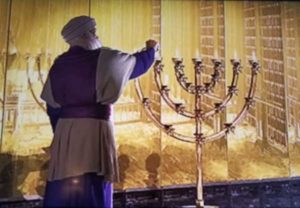
The Hanukkiah represents the legend of the oil lasting 8 days. It has 8 candles plus the servant candle. The Menorah from the temple has 6 candles plus the servant candle.
The Hanukkiah represents the legend of the oil lasting 8 days. It has 8 candles plus the servant candle. It is only used during Hanukkah. The Menorah of the temple, used year around, has 6 candles plus the servant candle.

This legend, which does not appear in the historical account in the book of the Maccabees, was written in the Talmud (Oral law) by Jewish sages in the 3rd century AD. It tells of the event of the cleansing of the Temple before the dedication, that the Maccabees looked for oil to light the lamps on the Menorah (lamp-stand) but found only a small container of pure olive oil bearing the seal of the High Priest Yochanan. The oil was sufficient to burn only for one day. By a miracle of God, it continued to burn for eight days, until new oil was made available. The story of the oil miracle has been retold for generations to give the holiday a more spiritual meaning in addition to giving thanks for the miracle of the restoration of the Holy Temple.

Filed Under: From the Newsletter, Holidays Tagged With: Chanukah, Hanukkah

Terror Strikes Israel

November 26, 2018 By Bella Davidov 1 Comment

Direct Gaza rocket hit into an Ashkelon apartment.

When Israel withdrew from Gaza in 2005, Israelis left their homes, greenhouses, and farms intact. Immediately, the Palestinians entered and destroyed everything. And as soon as Hamas took control by force in 2007, they spent all international monies donated to them on rockets, ammunition and building tunnels.

Hamas terrorizes Israel by firing thousands of rockets indiscriminately into southern Israeli cities and villages. They even use their own citizens as human shields and store rockets near or even inside hospitals, mosques, and schools. They fire rockets from residential areas and civilian facilities and dig tunnels from beneath homes and civilian institutions.

Despite the terror attacks, and for humanitarian considerations, Israel continues to supply electricity and water to the Palestinian people. Thousands of truckloads of supplies of meat, vegetables, canned food, milk products medical and school supplies and more from Israel have crossed into Gaza for consumption and use by the citizens.

Hamas could have decided to improve the economy and offer Palestinians a better life. Instead, it has focused only on attacking Israel and maintaining its goal of “return” to Palestine (the entire land of Israel) and the destruction of the Jewish state.

Hamas concentrated on building tunnels: Tunnels to Egypt brought consumer goods, fuel and, of course, weaponry; tunnels into Israel were to kidnap or kill Israelis and infiltrate Israeli territory. However, Egypt has closed the tunnels, and Israel has developed high-tech capabilities to detect and destroy them.

In the last eight months, Hamas has mobilized thousands of Gazan civilians on the border fences along with its own armed men; carrying grenades, guns, and other weapons. The goal is obviously to enter Israel, in order to kill and destroy as much as possible. With Israeli soldiers defending the border, all are pushed back, except for a few who are caught and arrested. Several who cut through the wire fence were shot, killed or wounded. Despite all this, every Friday, after their prayers, Hamas calls its citizens to storm the border fence by the thousands. Unfortunately, they were able to destroy Israeli border fields, trees, and livestock with fire.

If only Hamas would stop using its citizens in their fight against Israel; if only they understood that their dream of destroying Israel and taking over the land is a fantasy that will never come true. If only they would concentrate on economic recovery rather than building tunnels and amassing Iranian rockets and missiles. If only they would cooperate with Fatah and put away their arms. If only they would recognize Israel’s right to the land. Then there would be peace and quiet.

Should Israel topple Hamas and then leave? There is a real risk that either an ISIS affiliate or Islamic Jihad would take over. Both are much more militant than Hamas, and things would get worse. War with Hamas, who uses its own people as human shields, would cause many civilian casualties, including women and children. The ensuing global anti-Israel outcry would seriously hinder present Israeli diplomatic efforts for support against Iran. This would obviously be most sorrowful, especially in light of Israel’s new relations with Sunni moderate Arab nations, such as Saudi Arabia and the Gulf nations, who oppose Iran.

For these reasons, Netanyahu agreed to the cease-fire, hoping that the Egyptians will help Israel achieve quiet at least for a bit longer.

Filed Under: Conflict, From the Newsletter, Politics Tagged With: Gaza, Hamas, Palestinians

Israel: A Jewish State

August 29, 2018 By Bella Davidov Leave a Comment

God says that the Land of Israel is His land, and the city of Jerusalem is His dwelling place.

“…I will enter into judgment against them (the nations)… for they scattered My people among the nations and divided up My land.”   Joel 3:1-2

“For the Lord has chosen Zion; He has desired it for His dwelling place”
Psa. 132:13
“Blessed be the Lord out of Zion, Who dwells in Jerusalem!”  Psa. 135: 21

God made an everlasting covenant with Abraham – to give him and his descendants the land of Canaan for an EVERLASTING possession and make them into a great nation

Abraham had a son from his wife’s Egyptian maid Hagar – Ishmael. In Gen. 17:18,19 Abraham pleaded with God:

“Please let Ishmael be the son you promised,” God said: “NO, Sarah your wife shall bear you a son, and you shall call his name ISAAC; I will establish My covenant with him for an everlasting covenant, and with his descendants after him.”

Then God chose to continue the lineage with the younger of Isaac’s twins, JACOB. God changed Jacob’s man-given name to ISRAEL, which contains His name – El means God in Hebrew. God said to Jacob:

“And the land which I gave Abraham and Isaac, I also give to you, and I give this land to your descendants after you.“  Gen. 35:12

The nation of ISRAEL – the 12 children of Jacob/Israel became the 12 tribes of Israel who formed the Nation of Israel. God calls Israel His first-born (among nations). As a good father, God had to discipline His children in different ways but never stopped loving them. One of the punishments included being under foreign rule in their own land and expulsion from the land. The Jews went into exile twice, but God promised to gather them from all the nations where they were scattered and bring them back to the Land of Promise, the Land of Israel (formerly Canaan.)

Second Diaspora

In 70 AD, the Romans who occupied Judah destroyed the city of Jerusalem and the Jewish Holy Temple. Most of the Jews were taken into captivity and exiled. The Romans renamed the land Palestine, a name that remained through the different conquerors who came and went throughout the centuries, including the Christian crusaders and Muslim Arabs. All who lived in the land of Palestine were called Palestinians, both Jews, and Arabs.

God’s Promises and Prophecies Fulfilled

…” I will bring them back into their land which I gave to their fathers.”
Jer. 16:14-15
…“I will bring my people Israel back from exile.”   Amos 9:13

Israel: a Jewish State

Slowly the Jews began to come to Palestine as pioneers in the 19th century while it was under the Turkish Ottoman Empire for 400 years.

On November 17th, 1917, after winning WWI, United Kingdom of Britain Foreign Secretary and former Prime Minister, Arthur Balfour, made a formal declaration that a Jewish state should be established in Palestine.

On July 24th, 1922, Fifty-one member countries – the entire League of Nations (later to become the U.N.) – unanimously declared: “Whereas recognition has been given to the historical connection of the Jewish people with Palestine and to the grounds for reconstituting their national home in that country.”

They appointed Britain as the Mandatory for Palestine, with the explicit goal of “placing the country under such political, administrative and economic conditions as will secure the establishment of the Jewish national home.”

Political rights to self-determination for Arabs were guaranteed by the same League of Nations in four other mandates – in Lebanon and Syria (The French Mandate), Iraq, and later Trans-Jordan [The British Mandate]. Palestine was actually the ancient land of Israel.

More Jews returned to Palestine, bought land and built Jewish settlements, Kibbutzim, farms, and cities. A transformation started to happen as land that had lain desolate for 19 centuries started to bloom. Prophecies were fulfilled.

Ezekiel 36:8-11, ‘But you, O mountains of Israel, will produce branches and fruit for my people Israel, for they will soon come home. I am concerned for you and will look on you with favor; you will be plowed and sown, and I will multiply the number of people upon you, even the whole house of Israel. The towns will be inhabited and the ruins rebuilt. I will increase the number of men and animals upon you, and they will be fruitful and become numerous. I will settle people on you as in the past and will make you prosper more than before.’

World War II – 1930’s and 40’s – From the very beginning, the Arabs used violence to oppose the establishment of a Jewish nation in Palestine, and the British caved in to this violence and abandoned their international obligation to facilitate the establishment of a Jewish national home. The British didn’t abide by the League of Nation’s mandate, forgetting their promises of a Jewish homeland, but refused entry to Palestine to many Jewish refugees after 6 million Jews were murdered by the Nazis in WWII. In response to the 1936-1939 Arab revolt, Britain issued the White Paper which limited Jewish immigration to 75,000 for 5 years and ruled that further immigration was to be determined by the Arab majority. Restrictions were put on the rights of Jews to buy land from Arabs.

November 1947: The United Nations resolved that the Jews were to have their homeland in part of Palestine, while the Arabs will have the other part. Jerusalem would be an international city. While the Jews accepted this proposal, the Arabs rejected it. The 5 neighboring Arab nations declared war and attacked the newly established Jewish state from all sides. With little weaponry and a small army, Israel miraculously won the war and gained territory that included much of the land allotted to the Arabs. The borders were set, excluding the Old City of Jerusalem and Judea and Samaria remained in Jordanian hands. They renamed Judea and Samaria the ‘West Bank’. Jews fled the Old City. All Jews were denied access to the Old City and the Western Wall. Many holy places were desecrated.

In 1948, the British left and on the 14th of May 1948 Israel gained its independence and became the State of Israel. Israel made the western half of the city Jerusalem its capital.

1967: 19 years later, Israel won the 6 Day War against 3 of its enemy neighbors, and recaptured and Old city of Jerusalem and Judea and Samaria. New west Jerusalem and Old east Jerusalem were united under Israeli sovereignty as prophesied in Ps. 122:3.

“The LORD builds up Jerusalem; he gathers the exiles of Israel.” Psa. 147:2
“Jerusalem stands built up, a city that was joined together as one.” Psa. 122:3

United Jerusalem: Old and New

Ez. 37:21-22; Ez. 37:21-22:

“Surely I will gather the children of Israel from every side and bring them into their own land; and I will make them one nation in the land… of Israel…they shall no longer be two nations, nor shall they ever be divided into two kingdoms again.“

God is faithful to His word and His promises. Israeli soldiers stood with amazement in front of the Western Wall for the first time in their lives. The Israeli commander exclaimed: “The Temple Mount in our hands.” And there was much excitement in the land. But the Arabs and many Gentile nations rejected the outcome of a war they started, and they have continued to come against the nation of Israel.
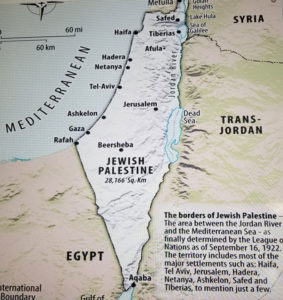
Israel and its neighbors.

Until 1948, all who lived in Palestine, were called Palestinians, Jews and Arabs. After winning the war of Independence in 1948, Israel changed the name of Palestine back to the original God-given name of Israel. All Jews in Israel are now called Israelis, but the Arabs kept the name

Palestinians cover all of Israel with their flag.

Palestinians. Now they are teaching in their schools that all of the Land of Israel is occupied Palestine, and that one day it will belong to them.

Iran, Hamas, Hezbollah, and Muslims worldwide want to destroy Israel.
Israel is surrounded by Muslim enemy nations who still seek to destroy the Jewish nation.


But . . .according to the word of God…

“The Lord has sworn: ‘For I will defend this city (Jerusalem) to save it for mine own sake, and for my servant David’s sake.’”   Isa. 37:35

Filed Under: Conflict, From the Newsletter, History

  • « Go to Previous Page
  • Page 1
  • Interim pages omitted …
  • Page 8
  • Page 9
  • Page 10
  • Page 11
  • Page 12
  • Page 13
  • Go to Next Page »

Primary Sidebar

  • Return to Home Page
  • Email

War

They Shall Come Back

And they shall come back from the land of the enemy. There is hope in your future, says the Lord, your sons shall come back to their own border.  Jeremiah 21:16b-17 This happened today, Monday October 13. Exactly two years ago, on the Holiday of Succot (booths), Hamas brutally attacked southern Israel from Gaza, murdering 1,200 Israelis and abducting 251 into […]

U.S. President Trump’s Epic Fury -Where Is It Going?

March 26, 2026

"אַרְיֵה שָׁאָג מִי לֹא יִירָא " "The lion has roared, who will not fear?..." Amos 3:8a The world is trying to understand President … [Read More...] about U.S. President Trump’s Epic Fury -Where Is It Going?

Recent Posts

  • Best Allies
  • U.S. President Trump’s Epic Fury -Where Is It Going?
  • Israel at War with Iran – Operation Roaring Lion
  • The Jewishness of Christmas
  • Hamas in America

Categories

© MMXXVI Yeshuatami, Ashdod ISRAEL