• Skip to primary navigation
  • Skip to main content
  • Skip to primary sidebar
  • Return to Home Page

Yeshuatami News Blog

All Things Israel

  • Conflict
    • Terrorism
  • History
    • Aliyah
    • End-time Prophecy
  • Politics
    • US
  • Israel
    • Holidays
    • Our People
  • From the Newsletter
    • Newsletter Archive
  • Give

Politics

The Deal

May 8, 2018 By Bella Davidov Leave a Comment

“Therefore I exhort first of all that supplications, prayers, intercessions and giving of thanks be made for all men, for kings and all who are in authority”            I Tim. 2:1-2.

Posted: May 8, 2018

The Deal

“Iran lied” – announced Israeli Prime Minister Benjamin Netanyahu as he presented material on Iranian nuclear weapons development. Netanyahu, who has repeatedly called for the deal between world powers and his country’s main enemy to either be altered or abolished, gave a PowerPoint presentation live on TV. He displayed maps, illustrations, and animations that he said provide proof that Iran pursued a nuclear program.
Netanyahu claimed that after signing the deal in 2015, Iran intensified its efforts to hide its nuclear files. In 2017, Iran moved its secret nuclear weapons files to a highly secret location in Teheran. From the outside, this was an innocent looking compound, but inside it contained Iran’s secret atomic archives locked in massive vaults. Very few Iranians knew of its location, and also a few Israelis.
          In a great intelligence achievement, the Israeli Mossad agents were able to get in and take out half a ton of the material inside the vaults where the files were kept. They were able to get them to Israel, 55,000 pages in big folders, and 55,000 files on 183 CDs. “We’ve known for years that Iran has had a secret nuclear weapons program,” he added, presenting slides of what he called Iran’s secret nuke files.
Netanyahu said Israel had obtained the documents in February and shared all of the information with the U.S. “I’m sure he’ll do the right thing for the United States, the right thing for Israel and the right thing for the peace of the word,” Netanyahu said of President Trump. “The Iran deal is based on Iranian lies and deception,” he added.The incredible Israeli intelligence operation of obtaining this huge treasure of information did several things:
First, it proved that Iran didn’t abandon its nuclear program and that Iran’s claim that the ballistic missile program was not intended to carry nuclear warheads is untrue.
The Iranians themselves admit they planned to build nuclear warheads and install them on missiles. Thanks to this new and powerful information, it is now crystal clear that the Iranians never stopped their uranium enrichment efforts and plans to build nuclear weapons, which Israel vehemently opposed and consistently fought against.
No one knew the archive existed before Israeli intelligence agents located it. Now the question prompted by the revelation of the archive is, what else is Iran hiding?
It is obvious now that Iran has safeguarded all its nuclear documents so that once the deal expires, it could pick up where it left off with research and production aimed at building nuclear weapons. The secret files also revealed that the Iranians lied about their nuclear weapons-building capability. There is a huge difference between what the Iranians say and what they actually do in reality.U.S. President Donald Trump has already spoken positively about Netanyahu’s unveiling, and European experts have traveled to Israel to study the findings. After this unveiling, it is no longer possible to ignore Israel’s warnings about Iran.
While all the other nations who signed the agreement with Iran, Britain, Germany, France, Russia, and China agree that Iran is a manipulative nation, they also agree that walking away from this imperfect deal would be far more dangerous than maintaining it. They claim that such a move would push Iran into a corner and that they would see developing nuclear weapons as their only way to break free of it. There is some logic to their position, but their interest is more economic and financial; European countries and Russian and Chinese companies desire to sign huge contracts with Iran.
The US and Israeli position is different. Israel and the U.S. hope to use the extremely narrow leeway, of at least three years until Iran will have the ability to develop nuclear weapons, to push Iran into potentially agreeing to a revised agreement that would include Tehran’s ballistic missile program and curb Iran’s regional interference, especially in Syria, where Israel determined not to let it happen.
“The argument that a bad agreement is preferable to no agreement is nonsense,” a senior US official said this week. “Without an agreement, Iran is exposed to an attack, to sanctions, and to diplomatic pressure.”  He believes the agreement frees Iran to continue lying and pursuing its goals.
Israeli officials said they believed even if the US was alone in re-imposing sanctions – while Russia, China, and European countries stayed in the deal – it would still put Tehran under major economic pressure.  Iran said about the huge amount of money they received from signing the deal that it was an “engine for empire” and allowed Tehran to bankroll proxy groups across the Middle East.   So, “The first thing sanctions would do is smash their “cash machine,” an Israeli official said.

     President Donald Trump to announce his decision on the deal at 2:00pm
US President Donald Trump was expected to announce his decision on whether to uphold the 2015 nuclear deal, which he has long criticized, by his May 12 deadline. Trump has hinted that he will pull out of the agreement unless it is revised. However, he is facing opposition from the other nations that are signed on the deal.
Trump decided to announce his decision on the Iranian deal today from the White House at 2:00 pm, 9 pm Israel time.
If Trump does announce that he is re-imposing sanctions on Iran, the sanctions would not kick back into force straight away – creating a window of time where the US might try to force Iran and Europe to accept a renegotiation of the agreement. President Trump “would be negotiating from a position of extreme strength” in such a scenario, an Israeli official said.
In case of the possibility that Trump will announce today that the US is pulling out of the deal. Iran is signaling conflicting messages, whereas the Iranian president Hassan Rouhani is hinting that the deal can be renegotiated, the foreign minister Muhamad Zarif warns the United States that Teheran will retaliate.
          Rouhani said yesterday that if the Americans will withdraw from the deal, Teheran’s condition to stay would be if the European Union will guarantee that his country will continue to benefit from it. “The United States would be then the main loser from the withdrawal.” He said. “Trump must know that our people are united, the Zionist regime (Israel) must know that our people are united.”
Iran has warned that if the US re-imposes sanctions it may resume enriching uranium, potentially putting it back on a path towards conflict with the US, Israel and its Arab rivals like Saudi Arabia.
          Iran’s Supreme Leader Ayatollah Ali Khamenei said: “They know if they enter a military conflict with Iran, they will be hit multiple times.”
Please pray, before 2:00 pm central time, for wisdom to President Trump, Iran’s leaders, world leaders and Israel. For God’s will to be done, He is sovereign.

We would love to hear from you – any comments, question and/or prayer requests. Thank you for your faithfulness in standing with us for the salvation of Israel, in prayer and financial support. We pray for you too from Zion, for God to supply all your needs and bless you greatly.

Filed Under: Newsletter Archive, Politics Tagged With: fake news, Iran

The Cases Against PM Netanyahu Now Under Investigation

March 20, 2018 By Bella Davidov Leave a Comment

PM Netanyahu

Case 1000

Netanyahu is suspected of accepting lavish gifts, worth about $280,000 throughout several years from billionaire friends, mainly Israeli-born Hollywood film producer Arnon Milchan and Australian billionaire James Pacher. The gifts include expensive champagne, cigars, jewelry, flights and hotel rooms. Netanyahu is accused of pushing for retaining a returned citizen’s benefits law, favorable to tycoons that would provide tax relief for Milchan worth hundreds of thousands of dollars.

Case 2000

Involves the leading Israeli newspaper Yedioth Aharonot, which is unfavorable to Netanyahu, and the daily free distribution newspaper Israel Hayom, (owned by American billionaire Sheldon Adelson, who is favorable to Netanyahu) that poses a serious financial threat to Yediot, especially its most popular weekend edition. Netanyahu is accused of conspiring with Yediot owner, Arnon Moses to help limit the distribution of Israel Hayom’s weekend distribution in return for Yediot giving him more favorable coverage and less favorable coverage to Netanyahu’s foes.

Police finished investigating both cases 1000 and 2000 and have recommended indicting Netanyahu for bribery, fraud, and breach of trust in both of them. It is now up to the attorney-general Avichai Mandelblit to investigate the police recommendations and decide whether it has enough evidence to prosecute Netanyahu. The process could take months. Recent opinion polls show public support for Netanyahu is still strong.

Although recordings of secret talks exist, Netanyahu denies any wrongdoing in both cases. In case 1000 he claimed the gifts were just gifts between friends, with nothing expected in return. In case 2000 he denied the allegations that he offered any favors in return for favorable coverage in Yediot, and that the recording of conversations with Moses was actually to catch Moses in his wrongdoings.

Case 3000

Case 3000 alleges bribes solicited during negotiations between a German industrial giant company and members of the Israeli government over the purchase of new submarines from the German company for Israel’s navy. Netanyahu is not a suspect yet, but several intimate associates of Netanyahu, including his former personal lawyer David Shimron, have been arrested on suspicion of the crimes.

Case 4000

Case 4000 is also known as the Bezeq (the national telephone company and communications giant, which includes Walla internet news site) corruption case. Suspects in bribe accusations include among others the controlling shareholder of Bezeq Shaul Elovitch, director-general of Israel’s Communications Ministry Shlomo Filber, and longtime Netanyahu family spokesman and close confidant Nir Hefetz. Elovitch in accused of illicitly allowing Bezeq to buy shares of Yes, a satellite cable provider, a move that would be benefiting Elovitch in hundreds of millions of dollars. He is also accused of ordering the Walla news site to give Netanyahu and his family favorable coverage in exchange for the prime minister advancing regulations in the merger with Yes.

Three allies turned witnesses for the State against Netanyahu.

The three men who were very close to Netanyahu were accused of bribery and were detained for investigations. At first, they claimed loyalty to Netanyahu, denying any of the allegations against him. Eventually, they were broken and made a deal with the police to save their own necks.

First to become the state’s witness in Case 1000 (gifts to Netanyahu from Arnon Milchan and others) and Case 3000 (submarines) was Netanyahu’s former chief of staff Ari Harow.

Then, in Case 4000 it was Shlomo Filber, who was director general of the Ministry of Communications when Netanyahu was serving as Minister of Communications. Harow and Filber have already given detailed and apparently incriminating testimony against Netanyahu.

The last one, and apparently the most damaging to Netanyahu was Nir Hefetz, former media adviser to the Prime Minister and a long time close confidant of the Netanyahu family. He was arrested on suspicion of bribery to help promote regulation worth hundreds of millions of dollars to Bezeq telecom company in return for favorable coverage of Netanyahu and his family by the Walla news website. At first, Hefetz said he did it on his own initiative. After signing the agreement to become a state witness, he changed his testimony and will receive in return full immunity. Police believe that Hefetz has a great deal of information about Netanyahu’s involvement in the various cases under investigation and that eventually, they will be able to get a conviction on Netanyahu in all the cases against him.

Netanyahu has denied wrongdoing in all the cases, saying he is the victim of a politically motivated media-driven witch hunt aimed at toppling him. Amazingly he has many supporters who believe in him, repeating his repeated slogan, that “There will be nothing because there is nothing.”

Filed Under: From the Newsletter, Politics Tagged With: Netanyahu, politics

False and Distorted History, Invented by the Arab Palestinians.

March 19, 2018 By Bella Davidov Leave a Comment

Long before the Palestinian Arabs started their terror campaigns against Israel (2000-2005), they were fighting a history war, with the goals of erasing the Jewish nation’s 3,000-year history in the Land of Israel, and that there is no connection between the ancient generation of Jews and the new generation. The Holocaust and other aspects of Jewish history are alternately denied, downplayed or distorted. Another distortion is replacing the Jewishness of Jesus, who lived in the Land of Israel with a Palestinian Jesus who preached Islam, thus denying not only Jewish history, but also the history and legitimacy of Christianity. The other goal is to replace the real history with a fabricated Palestinian history that invents ancient Palestinian, Muslim and Arab histories in the land.

Palestinian leaders are inventing their history for political purposes and as a strategy in their fight against the legitimacy of Israel in the Land of Israel. They have manufactured a false claim, that they are descended from Canaanites and are therefore the indigenous people of the area, present before the Hebrews occupied the land around the year 1500 BCE. “The Palestinians are the original owners of Palestine, who lived on its land when they moved from the western Mediterranean basin to its east in 7000 BC” It started first in 1998 at a conference of Palestinian historians when Chairman of History Department in Khan Yunis Educational College in Gaza, Dr. Yussuf Alzamili called on all universities and colleges to write the history of Palestine and to guard it, and “not to enable the [foreign] implants and enemies to distort it or to legitimize the existence of Jews on this land… “

These PA academics’ fictional claim that Palestinians Arabs populated the land of Canaan in Biblical times and even earlier are all historically impossible. First of all, the name “Palestine” instead of the Land of Judea/Israel was given by Rome in 136 C.E., centuries before Islam was established in 610 C.E. Second, Arabs first arrived in Israel with the Muslim invasion in 637 C.E. Nevertheless, this so-called claim that Biblical Canaanites were Arabs, is being broadcast many times on PA TV. For example: “The Arab Canaanites established ports on the coast of Canaan, known today as Palestine. Palestine was attacked by invaders, but its Arab Canaanite features withstood attempts to change them. Jaffa was one of the cities whose Canaanite origins the invaders failed to erase.” [PA TV, repeatedly, 2005-2007.]

Another distortion of history is that the Arabs are the victims of exile from the land caused by the Roman invasion, not the Jewish kingdom of Judea. “Seventy years have passed since Palestine’s Nakba (tragedy,) from which 6 million Palestinian refugees continue to suffer from the cruelty of exile and loss of human security. They continue to wander the world after the loss of their peaceful and stable lives in their homeland. They are part of the 13 million Palestinians, whose country has not yet been recognized as full Member State of the United Nations, despite the numerous resolutions reaffirming their right to self-determination and statehood on their national land.
We are the descendants of the Canaanites that lived in the land of Palestine 5,000 years ago and continuously remained there to this day. Our great people remain rooted in their land. The Palestinian people built their own cities and homeland and made contributions to humanity and civilization witnessed by the world. They established institutions, schools, hospitals, cultural organizations, theaters, libraries, newspapers, publishing houses, economic organizations, businesses, and banks, with wide regional and international influence.
All of this existed before and after the Balfour Declaration issued by the British Government in 1917, a declaration by which those who did not own, giving to those who had no right. The British Government bears responsibility for the catastrophic consequences inflicted on the Palestinian people as a result…”

True and Documented History

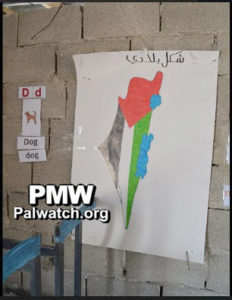
Fake map of Palestine - found in the school.
Map at PA school covers Israel in the Palestinian flag The picture shows the wall of a classroom on which is posted the PA map of “Palestine” that presents all of Israel as “Palestine” together with the PA areas, overlaid in the colors of the Palestinian flag. Text above map: “The shape of my land” Facebook page of the PA Ministry of Education

The Land of Israel changed to Palestina by the Romans after the expulsion of the Jews from the land in 136 C.E, was never an Arabic country or considered as such by geographers and historians. Historian Josephus, as well as other Roman geographers, placed Arabia beyond the boundaries of Palestina, (Judea as it was then called.) The land was conquered in 636 A.D by Muslims and occupied by Muslim-Arabs until 1071. A large percentage of the Arabs who now call themselves Palestinians are descendants of Arabs and Muslims who immigrated to the Land of Israel a few centuries ago illegally from Arab and Muslim countries.

The Palestinian Arabs or the Arabs of Trans-Jordan never ruled Palestina. The Arabs who conquered it came from the outside, they were not natives of Palestina. Conquerors like the Mamelukes and later the Turks, were not even Arabs or Semitic, but an entirely different race.

The “Holy Land” was conquered since 636 CE by various Arab, Muslim, and Christian rulers, dynasties and tribes, including, among others, the Abbasid dynasty (750 CE), the Egyptian Fatimid dynasty in 969 CE, the Turks and Seleucids in the eleventh century, the Crusaders (1099) and then back to the Egyptian Fatimid dynasty, and then to the Muslims of Sallah-a-Din, Turks, Tatars (1260), Egyptian kingdom, Mongols, and Ottomans (1517). In 1187 Saladin, who was not an Arab, but a Muslim Kurd from Iraq, defeated the Crusaders and conquered Jerusalem. He took over other parts of the country while the Crusaders maintained their hold over the rest.

After Saladin’s death in 1192, an agreement was signed by his successors with the Crusaders, allowing them to return to the Galilee. The Crusaders then moved their capital to Acre. The Muslim Mamelukes conquered the Land of Israel from the Crusaders in 1260 and ruled it until 1516, when it was taken over by the Ottoman Turks who ruled Palestina for 400 years. Their rule ended in 1918, and a Mandate over the country was given to the British, thus ending the Muslim rule in Palestina.

During the Muslim occupation of the land, waves of immigration of Arabs came from the Arabian Peninsula and the subsequent arrivals of Arabs from Transjordan, Sudan, Libya, and Syria. During the nineteenth century, many Arab families came also from Egypt, Albania, and other North African countries, which led to the continued settlement of Arabs in the country.

Research studies show that Arab clans living today in villages in Israel and Judea and Samaria trace their roots back to families who immigrated to Palestine in the seventeenth century onward from Saudi Arabia and Yemen and afterward from Transjordan. Other studies show that the many waves of immigrants came to the land from Arab countries also during the period of the British Mandate.

Most of the country was not cultivated, and it was only toward the latter part of the nineteenth century that the country began to blossom after the Aliya (going up to Israel) of Zionist Jews who settled in barren areas and started cultivating the land (bought by wealthy Jews) and drying out the swamps.

The Arab immigrants were drawn to the land because Jewish settlement there created the development of economic opportunities as well as improvement in sanitation and medicine. They were seeking to benefit and increase their income from the relatively advanced development and modernization in the area brought about by the Jewish population.

The huge Arab Muslim immigration into the area was noticed by world leaders like U.S. President Franklin D. Roosevelt and Churchill who remarked that the Arabs, who were not even persecuted, poured into Palestina since 1921, outpacing the immigration of Jews during that same period, until the Arab population grew more than the Jewish population.

To the above were added raids and movement by Bedouin tribes from the western desert since the late nineteenth and up to the mid-twentieth centuries.

When Jews began to immigrate to Palestina in large numbers in 1882, fewer than 250,000 Arabs lived there, and the majority of them were not longtime residents but relatively recent arrivals. Palestine was never an exclusively Arab country, although Arabic gradually became the language of the majority of the population after the Muslim invasions of the 7th century.

No independent Arab or Palestinian state ever existed in Palestina. In fact, Palestina is not even mentioned in the Koran, rather it is called “the holy land.” Palestinian Arabs never viewed themselves as having a separate identity. When the First Congress of Muslim Christian Associations met in Jerusalem in February 1919 to choose Palestinian representatives for the Paris Peace Conference, the following resolution was adopted: “We consider Palestina as part of Arab Syria, as it has never been separated from it at any time. We are connected with it by national, religious, linguistic, natural, economic and geographical bonds.”

The representative of the Arab Higher Committee to the United Nations submitted a statement to the General Assembly in May 1947 that said, “Palestine was part of the Province of Syria” and that, “politically, the Arabs of Palestine were not independent in the sense of forming a separate political entity.” A few years later, Ahmed Shuqeiri, later the chairman of the PLO, told the United Nations Security Council, “It is common knowledge that Palestine is nothing but southern Syria.”

The Arab and Zionist national movements shared the desire for independence in their homelands. But there was an important difference: The Zionists were united in their attachment to Palestina, in the Jewish minds it was always the Land of Israel, while the Arabs were divided by the competing interests of individual leaders from different lands throughout the region. Until 1948, all who lived in the Palestina were called Palestinians. There were Jewish Palestinians, Christian Palestinians, and Arab Palestinians.

Palestinian Arab nationalism did not become a significant political movement until after the 1967 Six Day War and Israel’s capture of the West Bank. Prior to that time, when they were primarily under Jordanian rule, Palestinians did not demand self-determination or statehood.

Filed Under: From the Newsletter, History, Politics Tagged With: Anti-Semitism, fake news, Palestinians, politics

Israeli Government Crisis – Over

March 14, 2018 By Bella Davidov Leave a Comment

While under the cloud of investigations against him, Israeli PM Netanyahu continues to run the government and foreign affairs at full speed. He has denied any wrongdoing and says he is the victim of a witch hunt. Just this week he was able to prevent the most serious crisis to date that threatened the coalition’s very existence and drag the nation into an early election. At a meeting with ministers of his Likud party on Sunday, Netanyahu said he was working for a stable government that would serve out its term until a national election due in November 2019.

The crisis erupted in recent weeks when the Council of Torah Sages demanded that Deputy Health Minister Yaakov Litzman’s United Torah Judaism party (UTJ) make his support for the 2019 state budget dependent on the passage of an amendment to the current conscription law that would solicit state recognition of Torah studies to being equal to military service. Kulanu chief, Finance minister Moshe Kahalon, threatened to leave the coalition if the voting on the budget did not take place on time.

The original amendment to the Conscription Law, which was established in the previous secular coalition, constituted a major breakthrough in bringing Haredim (Ultra-Orthodox religious Jewish men) into the military by setting an annual quota for Haredi conscripts, where Haredi men of military age were permitted to delay their service in case the annual quota of ultra-Orthodox conscripts was met. A little over two years ago, Netanyahu won another election, his forth as Prime minister of Israel. He had to form a coalition that included 13 members of Haredim. In the present government, they fought to change that law and a new one went into effect, reducing the quota of Haredi conscripts.

With the court’s ruling that the adjustment was unconstitutional however, which gained the backing of 8 out of 9 judges, the government will now be required to increase the quota of Haredi conscripts within one year. “We are compelled to return the matter back to the Knesset,” concluded Supreme Court Chief Justice Miriam Naor. “At this stage, it is clear that it is no longer enough to make do with non-binding and non-enforceable arrangements whose outcome is unknown.” According to the judges, the cap imposed following the Knesset’s ratification “harmed equality.”

The Haredi parties have decided on advancing the legislation as a basic law in order to prevent the High Court of Justice from intervening and striking it down. To become a basic law, the proposed legislation needs 61 votes to pass in Knesset and not just a simple majority.

The bill says that “Torah study is a foundational value in the heritage of the Jewish people,” and that “the State of Israel, as a Jewish state, sees supreme importance in encouraging Torah study and Torah students.” (by Torah, they include mainly the Oral Law)

It adds that the state “will see in those who dedicate themselves to studying Torah for an extended period as someone who does substantial service for the State of Israel and the Jewish people,” meaning in lieu of military service. They have stated explicitly that the law is designed to override the decision of the High Court of Justice, which ruled in September last year that blanket military service exemptions were discriminatory and harmed the principle of equality before the law.

The Haredi’s reasoning for the bill is that “Throughout the history of the Jewish people many tried preventing yeshiva students from studying, both within and without the Jewish people. Some used force, others different methods. Neither has ever been able to halt the study of the Torah, nor will they. Those studying Torah will continue their studies, with or without the High Court. I categorically reject the court’s ruling and we’ll rectify this situation in the coming year and there’s nothing they can do about it, as the judges don’t have any idea what studying the Torah means or that our entire existence is predicated on them continuing to do so, as is the entire world’s.” The Council’s members instructed the Haredi MKs (Members of the Knesset, Israeli government parliament) to continue insisting on a new bill passing all three of its readings for approval before voting on the state’s 2019 budget. “That means simply elections,” a United Torah Judaism (UTJ) said.

After the Council’s approval, the bill will be placed on the Ministerial Legislation Committee’s docket and then sent to a preliminary Knesset reading, without Defense Minister Avigdor Lieberman’s party members having to vote for it.

The bill is based on a framework put forward by Shas Knesset member Yoav Ben-Tzur, which states that a goal will be set of 3,800 Haredi recruits joining the IDF (Israeli Defense Force) and national service with each recruitment cycle—with their number gradually increasing. A letter disseminated to Haredi MKs by the Council’s secretary said, “I have been asked to inform you that the Council of Torah Sages’ decision to pass the yeshiva student draft bill before approving the budget has remained unchanged and that you must follow it.”

In addition, the law will omit any sanctions or incentives, instead including an article stating that the government will inspect general draft quotas every five years and if it finds Haredi conscripts failed to meet them, the law will expire.

Despite estimates that an accord may yet to be reached with the Haredi parties, Likud remains unsure about how to solve the political crisis with defense minister Lieberman, who flatly refused to vote on bills considering the military without promulgated by a professional defense establishment committee.

Another problem that remains to be tackled is the defense minister’s statements that members of his party will vote against the bill.

A Likud source voiced some optimism at the conclusion of Litzman’s meeting with the PM. “We’re trying to promote a compromise with the Haredim, but Lieberman’s assent is also required,” he said.

Trying to reach a compromise with the Haredim, Netanyahu met with the heads of the coalition to discuss the matter of the draft bill further, so the crisis surrounding the draft bill could be resolved.

“The meeting of coalition heads took place with a good atmosphere. There is still no agreed-upon wording between the Haredi parties. Coalition heads are waiting for their draft and after that the discussions will continue in order to resolve the crisis,” a statement by the Prime Minister’s Office said.

After days that every side stayed firm on their demands, the unwillingness to go to elections prompted coalition members to work on a compromise that will include alterations to the proposed amendment of the bill.

Defense Minister Avigdor Liberman promised that his own political party, “Yisrael Beytenu would support a bill only if it is drafted by the defense establishment and the IDF. On the matter of security, there is no compromise.”

On Wednesday, Netanyahu was able to broker a compromise deal acceptable on all sides, and the crisis is over.

The deal managed to strike a delicate balance, ensuring that the conscription bill passed the same evening in its preliminary reading in the Knesset Plenum, but all factions were given the freedom to vote as they please.
Finance Minister Moshe Kahlon’s (Kulanu) 2019 state budget will pass all three readings in the Knesset in the near future, while the nationality bill will be brought to a first reading vote no later than Thursday.

The bill passed with a 59 MK majority, with 38 MKs voting against it, including Landver, with no abstentions.

“I promised to continue the existence of the government and I delivered. I am grateful to my partners in the coalition who demonstrated responsibility so that we can continue to lead the State of Israel with determination and success—in security, in the economy, in social matters, and in foreign diplomacy,” Netanyahu proudly proclaimed from the podium as he addressed the Knesset Plenum.

Defense Minister Avigdor Lieberman was also pleased, “The deal that we stood for all along has been fully accepted. Yisrael Beytenu (his party) will vote against the draft-dodging bill. Until the beginning of the summer session, a professional team in the Defense Ministry will formulate a bill proposal, which will itself form the basis of a governmental bill, while legislation on religion and state will be frozen. The legislative process will continue with the law being incorporated into a Defense Ministry governmental bill agreed upon by all coalition factions and coordinated with Attorney General Avichai Mandelblit.”

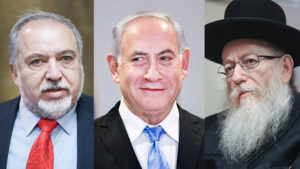
From left, Avigdor Lieberman, PM Netanyahu and Yaakov Litzman

From left, Avigdor Lieberman, PM Netanyahu and Yaakov Litzman

Filed Under: From the Newsletter, Politics, Today

The Story of Purim

February 28, 2018 By Bella Davidov Leave a Comment

The year in which the story of Purim occurs is 357 BC. There were many Jews who decided to stay in exile in Persia after the return of the rest of the Jews to the Land. The king of the Persian Empire, Ahasuerus (Xerxes) was showing off all his splendor and great riches in a big banquet and wanted also to show off the beauty of his queen Vashti, who made a banquet of her own for the women. Vashti refused to come and aroused the king’s anger, who decided to get rid of her and choose another queen.

Of all the beautiful virgins of the empire, the one whom the king fell in love with and chose to be his queen was a stunning beautiful Jewish young orphan, named Hadassah, known by her Persian name, Esther. Her uncle who raised her, Mordechai the Jew urged her not to reveal her nationality, and Esther joined the king’s royal harem.

The king raised to power Haman the Agagite (descendant of Amalek) to a position above all the other princes and ordered that all who were at the king’s court had to bow down to him. Mordechai the Jew, who sat at the king’s gate was the only one who refused to bow down to Haman and aroused his anger. When Haman learned that Mordechai was Jewish, he manipulated King Ahasuerus into ordering the genocide of all the Jewish people throughout the empire.

Haman said to the King Ahasuerus: “There is a certain people scattered and dispersed among the people in all the provinces of your kingdom, their laws are different from all other people’s, and they do not keep the king’s laws. Therefore it is not worthy for the king to let them remain…let a decree be written that they be destroyed…” (Esther 3:8-9)

The Pur (dice or lot) was cast and fell on the thirteenth day of the month of Adar, in one day all the Jews were to be, according to the words of Haman’s decree, “killed, destroyed, and annihilated.” (Esther 3:13) It was done, a decree that cannot be changed because “in the name of King Ahasuerus it was written and sealed with the king’s signet ring.” (Esther 3:12c)

A big cry and mourning were heard throughout the Jewish communities, and when Mordechai heard the terrible news he tore up his clothes, put on sackcloth and ashes on his head, went out to the center of the city and cried out a loud and bitter cry. He sent a message to Esther telling her that she must go to the king and plead for him to change the decree. Even though the king loved Esther, he didn’t send for her in thirty days. She said that everyone knows that if anyone goes to see the king without being invited, he or she must be put to death by law unless the king extends to him or her his royal scepter.

Mordechai sent a message to Esther in reply, “don’t think that you alone will be saved out of all the Jews just because you are in the king’s palace. If you keep silent at this time…relief and deliverance will come to the Jews from another source…”

Mordechai had faith in the God of Israel that He would not let his people be exterminated. He knew that God had a purpose and plan for Israel. He told Esther “Who knows whether you have come to the kingdom for such a time as this?” (Esther 4:14)

Esther decided right away to take a courageous step of faith and go to the Higher Authority in prayer and fasting. She called for the entire Jewish community in the capital city to stand with her in prayer and fasting for three days as she risks her life for the chance of saving her people. She is going to go unlawfully before the king uninvited. and “if I perish, I perish.”

On the third day of the fast, Esther put on her royal robe and stood across the King’s royal throne. When the king saw her, she found favor in his eyes and he extended to her his royal scepter as an invitation to come to him. As she came and touched the scepter, he asked what her request was, and he would give her up to half the kingdom. All she asked was to invite the king and Haman to a royal banquet she prepared for them. After the banquet, the king repeated his question to know what she really wanted of him, as he was willing to give her half the kingdom. Again Esther replied that she was inviting him and Haman to another banquet. Haman was so elated and proud that the queen chose to honor him, but when he passed by Mordechai who wouldn’t bow down to him, his joy turned to rage. He listened to his wife’s suggestion and built a tall gallows to hang Mordechai on, after getting the king’s approval.

Here is where the story takes a twist and turn, and we see the hand of God.

That night the king couldn’t sleep. He asked that his servant read to him from the book of remembrance. The account he heard was how Mordechai saved his life by exposing the plot to assassinate the king by two servants, who were caught and executed. He found out that Mordechai was not rewarded for this act. In the morning he ordered to bring to him the first person who came into the court to use in order to honor and repay Mordechai for saving his life. The first person who walked into the court was Haman, who wanted to get the approval of the king to hang Mordechai. When the king asked him what should be done to the person the king wants to honor, Haman in his pride was sure the king meant him. He told the king that that person should be dressed in royal attire, someone should parade him on a royal horse through the streets in the center of the city and announce that this is what is done to the person whom the king favors. King Ahasuerus ordered Haman to do it to Mordechai. When Haman came home shamefully and told his wife what happened, she said to him, “If Mordechai is of Jewish descent, you will not prevail against him but surely fall before him.” (Esther 6:13)

At the end, in the second banquet, Esther revealed to the king her being Jewish and the plot of Haman to annihilate all of the Jews. The King ordered to hang Haman on the very gallows he built for Mordechai and promoted Mordechai to a high position in the kingdom. The king gave him his signet ring to write a new decree for the Jews to destroy all those who would seek to kill them. That is how the Jewish people were saved from annihilation. In the end, God gave His people the victory over all their enemies. Once again God proved that His promise and covenant with Israel is everlasting.

Filed Under: From the Newsletter, History, Politics

  • « Go to Previous Page
  • Page 1
  • Interim pages omitted …
  • Page 4
  • Page 5
  • Page 6
  • Page 7
  • Page 8
  • Interim pages omitted …
  • Page 10
  • Go to Next Page »

Primary Sidebar

  • Return to Home Page
  • Email

War

They Shall Come Back

And they shall come back from the land of the enemy. There is hope in your future, says the Lord, your sons shall come back to their own border.  Jeremiah 21:16b-17 This happened today, Monday October 13. Exactly two years ago, on the Holiday of Succot (booths), Hamas brutally attacked southern Israel from Gaza, murdering 1,200 Israelis and abducting 251 into […]

U.S. President Trump’s Epic Fury -Where Is It Going?

March 26, 2026

"אַרְיֵה שָׁאָג מִי לֹא יִירָא " "The lion has roared, who will not fear?..." Amos 3:8a The world is trying to understand President … [Read More...] about U.S. President Trump’s Epic Fury -Where Is It Going?

Recent Posts

  • Best Allies
  • U.S. President Trump’s Epic Fury -Where Is It Going?
  • Israel at War with Iran – Operation Roaring Lion
  • The Jewishness of Christmas
  • Hamas in America

Categories

© MMXXVI Yeshuatami, Ashdod ISRAEL