• Skip to primary navigation
  • Skip to main content
  • Skip to primary sidebar
  • Return to Home Page

Yeshuatami News Blog

All Things Israel

  • Conflict
    • Terrorism
  • History
    • Aliyah
    • End-time Prophecy
  • Politics
    • US
  • Israel
    • Holidays
    • Our People
  • From the Newsletter
    • Newsletter Archive
  • Give

Lebanon

Iran’s Massive Direct Attack on Israel

October 15, 2024 By Bella Davidov Leave a Comment

Deuteronomy 20:3

He shall say: “Hear, O Israel, today you are going into battle against your enemies. Do not be fainthearted or afraid; do not be terrified or give way to panic before them. For the LORD your God is the one who goes with you to fight for you against your enemies to give you victory.”

A Second Direct Attack From Iran

Image

The October 1st Iranian ballistic missile attack on Israel included over 200 ballistic ground-to-ground missiles targeting the entire populated areas in the land of Israel. Thankfully, most were intercepted by the IDF’s multi-layered air defense network. US forces in the region also intercepted some of the Iranian missiles.
[Picture From Facebook – the remains of a ballistic missile in the Dead Sea]

The IRGC, The Islamic Revolutionary Guard Corps, an Iranian military arm, excuse for the missile strike was retaliation for the assassinations of the Hamas leader Ismail Haniyeh in July and Hezbollah leader Hassan Nasrallah on September 27th, as well as the killing of Lebanese and Palestinian people.

This was Iran’s second attack on Israel after its  very first direct attack on Israel on the night of April 13th, 2024 with ballistic and cruise missiles and bomb-laden unmanned aerial vehicles. That strike was a response to the Israeli air strike on the Iranian Consulate in Damascus that killed Brigadier General Mohammad Reza Zahedi, commander of the IRGC’s Quds Force.

In addition to the usual use of its many proxies, Iran has attacked all of Israel directly by firing more than 300 missiles and suicide drones.

In response, Israel has launched a series of missile strikes on Iranian military sites, including one near Isfahan, Iran’s main nuclear research facility as well as other strategic military strikes. According to many Israeli opinions, it was a weak symbolic attack yielding to Biden’s request to avoid escalation. Nevertheless, it had some significance in exposing Iran’s weak defense systems.

The second Iranian attack October 1st sent the entire Israeli population to bomb shelters while Iran launched a barrage of ballistic missiles everywhere.

In response, Prime Minister Benjamin Netanyahu said that Iran “made a big mistake and will pay for it” and that Iran “does not understand” Israel’s “determination to retaliate” against its enemies. “They will understand,” said Netanyahu. “We will stand by the rule we established: whoever attacks us – we will attack.”
(Picture of a Bibi from USA Today)

In the two attacks, Iran has fired about 500 missiles and drones, and thank God, not a single Israeli has been killed. There have been just a few injuries and little damage.

Now the question is how and when Israel’s retaliation will occur. Israel has several options. 

Iran’s Nuclear Weapon

Iran’s ability to produce a nuclear weapon is an existential threat to the Jewish state. striking Iranian nuclear facilities would be Israel’s first response to the Iranian massive attack.

However, while still claiming that America’s commitment continues to be very clear and ironclad on Israel’s security, US President Biden demands “an Israeli response that will look powerful but will not ignite the region and still put an end to the story.”

Image

U.S. Gen. Michael Erik Kurilla, commander of US Central Command, is due to arrive in Israel over the weekend for what will likely be a series of meetings to discuss the situation. The main concern of the U.S. is that the Gulf States will be harmed as a result of Israel igniting the region through a massive attack on Iran’s oil and/or nuclear facilities. There were media reports of Iran threatening Saudi Arabia and other Gulf states oil facilities should Israel attack the same Iranian facilities.
Lt. Gen. Michael Kurilla testifies before the Senate Armed Services committee during his confirmation hearing on Feb. 8. (Susan Walsh/AP) Picture from DefenseNews

PM Netanyahu has threatened Iranian nuclear ambition for many years. Many in Israel see this planned retaliation as a window of opportunity for Netanyahu to do so. However, Israel has to consider the complexities and numerous consequences of such a strike. To be well protected, Iran has intentionally spread the nuclear sites across the country. The sites are hidden under rocky mountains, more than 1,000 miles away from Israeli Air Force bases, making it hard if not impossible to be targeted and cause severe damage.

However, Israel has spent years developing capabilities not yet seen in action.

The attacks on Isfahan and in Yemen demonstrate the Israeli air force can reach anywhere. 

American Directives

President Joe Biden suggested last week that Israel should not strike Iran’s oil and that he opposed strikes on Iran’s nuclear sites. Nevertheless, Israel is considering attacking Iran’s oil facilities or ports. Oil is critical to Iran. This could have severe consequences on global oil markets.

What Will Israel Do?

Another option is to strike government symbols, or military targets. Striking Iran’s missile depots would limit Iran’s capability to manufacture missiles. Such an attack would ignite the weapons and produce a spectacle for all the world to see. Hopefully, this would reinforce Israel’s deterrence among its enemies in the region. Can Israel eliminate all the threats from the head of the octopus and its proxies by using only military force?

We need to pray for wisdom to make the right decision at the right time. With God’s help, we pray for a supernatural victory.

“As long as the enemy threatens our existence and the peace of our country, we will continue to fight. As long as our hostages are still in Gaza, we will continue to fight,” Netanyahu said in a pre-recorded television address, vowing not to give up on the “sacred mission” of achieving the war’s goals.

Last year on Yom Kippur, Israelis observed the holy day as usual  – kids riding bicycles in the streets and people attending local synagogues. Then October 7th happened – Black Sabbath!. This year many have truly joined in the whole month of repentance leading up to tonight – Yom Kippur. We pray that the Lord touch  our hearts as in the days of Esther, when the whole nation participated in repentance and fasting.
pray for our people in the synagogues that as they chant the regular prayers of repentance the Lord touch those hearts that truly seek Him, to return to Him through our Messiah Yeshua and worship Him in Spirit and in Truth. 

Filed Under: Conflict, From the Newsletter Tagged With: Gaza, Hamas, Israel Threatened, Lebanon, Terrorism, War

Does Lebanon Have Complete Control Over its Diplomatic Agenda?

September 23, 2024 By Bella Davidov Leave a Comment

For the past eleven months, Hezbollah, the pro-Iranian militia, has been fighting Israel in solidarity with Hamas in Gaza. While neither Hezbollah nor Israel appears to seek an all-out war, the situation could spiral out of control. On the ground, the risk of escalation is very real. Washington and Paris have decided to “coordinate closely” concerning Lebanon to avoid such an escalation.

Meanwhile, Hezbollah continues to expand its influence. In addition to the financial support it receives from Iran (several hundred million dollars yearly according to the U.S.), the militia receives donations from the Lebanese Shia diaspora and profits from both its legal and illegal (drug trafficking) businesses. Since the 2000s, Hezbollah has developed an integrated economy organized around a bank (al-Qard al-Hassan), powerful charities, and the al-Sajjad network of local supermarkets, offering discounts on basic goods. These economic structures insulate the southern region from the rest of Lebanon, and now, protect it from the effects of the national economic crisis.

Hezbollah has adopted a wait-and-see attitude. With patience it takes its time, counting on the slow disintegration of the country, weakened by double-digit inflation.

Michel Aoun – Image from Simple Wikipedia

Lebanon has been governed by a caretaker cabinet since Prime Minister Hassan Diab resigned in August 2020 amid protests demanding accountability for the Beirut blast, when a stockpile of highly explosive ammonium nitrate was stored improperly at Lebanon’s most vital port. Michel Aoun, the Lebanese president at the time, accepted the resignation of the government and the Prime Minister and asked the government to stay on in a caretaker capacity until a new cabinet was formed.

On 10 September 2021, Mikati was able to form a government of 24 members after long negotiations with President Aoun, and the various political parties. When he took office, Lebanon was in the grip of a very serious economic crisis: the collapse of the national currency, galloping inflation (the cost of food had jumped by 700% in the previous two years), massive layoffs, a poverty rate of 78% according to the UN, frequent power cuts, fuel shortages, etc. Mikati is depending on the solidarity of the Arab world to help the country out of its crisis.

Najib Mikati – Image from Wiki

Mikati has been backing the Shiite groups, Hezbollah and Amal, but faces resistance from Christian lawmakers. Mikati himself does not represent a political party.

Najib Mikati, a Lebanese politician and businessman, has served as the Prime Minister of Lebanon since September 2021. Mikati said after his nomination that his priority would be to implement a French-backed reform plan that would unlock much-needed foreign financial aid.

Lokman Slim, Image from Times of Israel

Different sectarian groups are operating in Lebanon. Lebanese politics is based on a power-sharing system among these groups, including Hezbollah. Hezbollah, a Shia Muslim organization that emerged in the 1980s, has by now near total control over its own community, which it also represents in parliament. Dissenting Shia voices against Hezbollah have all but disappeared following the assassination of a Shia public intellectual and vocal Hezbollah critic, Lokman Slim, in 2021. Supporters of Hezbollah had previously threatened Slim’s life.

The leaders of Lebanon’s two major communities, the Sunni Muslims and the Christians, and those of the smaller but politically powerful Druze community, have issued statements urging caution and restraint. Yet, some Sunni and Christian groups in particular are sympathetic to Hezbollah.

Unlike the secular Sunni Muslim Lebanese, who call for restraint, religious Sunni Islamist groups are now siding with Hezbollah against Israel since the start of the Gazan war and some have even gotten closer to the organization over the past nine months.

In the past, many Sunni Islamists in Lebanon were against Hezbollah after an intense brief burst of violence in 2008, when Hezbollah attacked Sunni supporters of the then-Lebanese government.

Another Sunni group is the Lebanese branch of the Muslim Brotherhood, whose Al-Fajr forces, however symbolic and limited, have participated in the hostilities against Israel in southern Lebanon alongside Hezbollah since late October 2023, and even lost seven of their fighters in May of 2024.

Lebanese Christians are divided into three political parties, and so is their position towards Hezbollah: the Kataeb and the Lebanese Forces (LF) on the anti-Hezbollah side, and on the other side the Free Patriotic Movement (FPM) which has broadly supported the Shia Hezbollah party since 2006.

In recent months, the leaders of both the LF and Kataeb have opposed Hezbollah’s war of attrition against Israel which they claim is provoking Israel to attack and devastate Lebanon. However, they are powerless against Hezbollah. Nevertheless, they complain that Hezbollah is acting and making decisions in the name of all Lebanese citizens.

Two other important Christian groups are the Patriarch of the Maronite church, Bechara Boutros Rai, and a rightwing private militia in eastern Beirut called Jnoud al-Rab (Soldiers of God).

Bechara Boutros Rai, Image from Catholic Weekly

Jnoud al-Rab claims that Hezbollah’s actions are endangering the country and Lebanon’s Christian community. In January 2024, the group hijacked flight screens at Beirut airport and displayed a message warning Hezbollah against engaging in war with Israel.

Since November 2023, Patriarch Rai has regularly issued statements against Hezbollah’s involvement in the Gaza war and has urged officials of the need to protect Lebanon.

In June 2024, he described Hezbollah’s activities in the south as acts of terrorism, which caused the Shia religious leadership to boycott the Patriarchate’s June spiritual summit.

Gibran Bassil, Image from the Arab News

As for the FPM party that has been favorable to Hezbollah, the relationship has become increasingly strained since October 2022, when the then president Michel Aoun’s term came to an end and Hezbollah refused to support EPM’s leading candidate as the new president and Aoun’s son-in-law, Gibran Bassil.

In April 2024, Bassil came around and declared that the FPM supports “the Resistance” (Hezbollah’s adopted name), but “rejects Hezbollah’s position to participate in the Gaza war without internal national consensus”.

Druze

The leading Druze politician, Walid Jumblatt, is the weathervane of Lebanese politics. Despite being retired, he remains an important voice for the Druze (who constitute around 5% of the Lebanese population).

Walid Jumblatt, Image from Arab News

In October, he called on Hezbollah “not to be dragged into the war”. He also took to social media asking Hezbollah not to participate in the war.

However, he clearly stated at the beginning of the conflict that he would side with Hezbollah should Israel attack Lebanon. And, since then, Jumblatt has noted that “the rules of engagement have changed”.

Lebanon’s major communities have largely been consistent in urging restraint and would prefer to see Hezbollah avoid a war with Israel. Should war break out, however, the sects of Lebanon will probably all rally around Hezbollah, as was the case in 2006.

History of Wars Between Israel and Lebanon

Since the end of the Six Day War, Palestinian terrorist militant groups have initiated attacks from south Lebanon against Israel, and even against Lebanese Christian militias inside Lebanon in the mid-1970s. In reprisal, the IDF, Israeli Defense Force have attacked in different operations, the most notable of which was the Litani Operation in 1978.

In 1975, the Lebanese civil war broke out, which lasted until 1990. With its own army operating freely in Lebanon, the PLO (Palestinian Liberation Organization) had created a state within a state in south Lebanon. By then, more than 300,000 Palestinians lived in Lebanon. Lebanon’s Muslims and leftists who supported the PLO sought more political power. The Christians, seeking to maintain their political dominance, opposed the PLO. The factions fought fiercely through early 1976, and Lebanon became divided, with the Christians in power in the north and the Muslims in the south.

Israel helped the Christian Maronite militias by supplying them with arms, tanks, and military advisers. Initially, Syria, fearing loss of commercial access to the port of Beirut, supported the Maronites who had the majority in the government. Later, however, Syria switched sides by supporting the Palestinians instead.

In 1982 the Israeli army entered southern Lebanon with the goal of destroying the Palestinian guerrilla bases. The battle resulted in the expulsion of the PLO from Lebanese territory and their relocation to Tunisia.

In 1989, Christian leader Gen. Michel Aoun attempted to drive Syria out of Lebanon but was defeated and the Arab League mediated a peace deal. Aoun’s removal from power in October 1990 marked the end of the civil war and eliminated one of the major obstacles to the implementation of the 1989 peace accord.

Following the PLO’s expulsion from Lebanon, the Israeli military and Lebanese Christian militias began fighting the growing Iran proxy Shia Muslim terrorist group, Hezbollah, in south Lebanon, marking the beginning of the ongoing fighting between Hezbollah and Israel.

Filed Under: Conflict, MainStoryWidget-left, Politics, War Tagged With: Hezbollah, Lebanon, Terrorism, War

Hezbollah: Not Just Fanatical Terrorists

September 23, 2024 By Bella Davidov Leave a Comment

The Hezbollah creed: “We are the children of the faction of God and we see ourselves as an integral part of the Muslim world, challenged by a most arrogant imperialist assault from the West and the East, with the aim of nullifying the gracious Muslim prophetic charge received by Allah. Allah has given it grace so that it can become the best community that has ever appeared on the earth: it prescribes good and dissuades from evil, and believes in Allah.”

“We see in Israel the vanguard of the United States in our Islamic world. It is the hated enemy that must be fought until the hated ones get what they deserve. This enemy is the greatest danger to our future generations and the destiny of our lands, particularly as it glorifies the ideas of settlement and expansion, initiated in Palestine, and yearning outward to the extension of the Great Israel, from the Euphrates to the Nile.”

“Our primary assumption in our fight against Israel states that the Zionist entity is aggressive from its inception, and built on lands wrested from their owners, at the expense of the rights of the Muslim people. Therefore, our struggle will end only when this entity is OBLITERATED. We recognize no treaty with it, no cease-fire, and no peace agreements, whether separate or consolidated.” Israel is “the ‘imperialist power’ which planted a ‘foreign entity in the region…a cancer that is propagated in the body of the Arab and Islamic umma (typically a single group of common religious beliefs) in order to reduce it to pieces, divide it and control its resources.”

Historical Summary of Hezbollah in Lebanon

The Shia Muslim Iran-proxy Hezbollah (“Party of God”) emerged amid the chaos of the Lebanese civil war as a guerilla terrorist group. It has now grown to become a national political entity, a social welfare unit, and a state-like military organization.

Image from NBC News: Hezbollah

Slowly but surely, and inconspicuously, Hezbollah has increased its political power and status within Lebanon. It has gained growing influence over Lebanon, careful to maintain the rules of the Lebanese political order. The group has, in fact, become so entrenched in the political system that it now demands increased decision-making power within Lebanon. In June 2017, after great efforts on the part of Hezbollah officials, the Lebanese parliament passed a new electoral law that significantly increased Hezbollah’s power in parliament and further secured its representation. However, Hezbollah’s plan is to remain a separate and autonomous armed group with its weapons in the name of “resistance.”

Following the 1982 war between the PLO and Israel in south Lebanon, Hezbollah grew and established its strength and prominence by conducting a series of terror attacks against Israel.

Following the Israeli withdrawal from Lebanon on May 24, 2000, Hezbollah became almost a state within a state in south Lebanon.

By 2005, Syria completely withdrew its forces from Lebanon, leaving a power vacuum. Then, in 2006, Hezbollah provoked Israel into a full-scale war in south Lebanon after abducting two Israeli soldiers. After 34 days of fighting, the UN brokered a ceasefire by its Security Council Resolution 1701 which established a no-man zone in south Lebanon that disallowed both Israeli and Hezbollah forces from entering. This was in addition to the UN Security Council Resolution 1559, passed in 2004, which called for the disarmament of all armed militias, as well as their cooperation in allowing the Lebanese State to assert its sovereignty in a free and functioning political system.

However, not only did Hezbollah refuse to give up its weapons but it has systematically increased arms and ammunition throughout south Lebanon since 2006. It has continuously used its weapons to eliminate political rivals as much as possible and impose its will on the Lebanese people and the government. In addition to receiving arms transfers from Iran, Hezbollah is also building infrastructure for independent arms production within Lebanon.

At the end of the 2006 war against Israel, the UN Security Council Resolution 1701 cease-fire agreement called for Hezbollah to immediately stop all attacks and for Israel to cease all offensive military operations. In addition, it set guidelines for both parties, under certain conditions, to refrain from hostilities and maintain stability. Whereas Israel kept the conditions of the agreement, Hezbollah overtly and consistently violated and continues violating the terms agreed upon in the resolution.

In December 2018, IDF forces uncovered an extensive network of underground terror tunnels crossing the Blue Line (a demarcation line dividing Lebanon from Israel and the Golan Heights, published by the United Nations on 7 June 2000 for the purposes of determining whether Israel had fully withdrawn from Lebanon.) This was in clear violation of UN Security Council Resolution 1701. Hezbollah dug these tunnels with the intent of carrying out surprise attacks and kidnappings of Israeli civilians and soldiers. During Operation Northern Shield, the IDF successfully exposed and neutralized these tunnels.

Hezbollah Sabotages the Work of UNIFIL

UNIFIL (UN peacekeeping forces) is supposed to enforce the resolution. However, Hezbollah works in various ways to disrupt the activity of UNIFIL which renders it helpless against Hezbollah militant operations and intelligence gathering or transferring arms. Hezbollah’s influence over the Lebanese government and army is growing steadily.

The means by which Hezbollah increased its control in Lebanon:

  • In the financial system: in order to evade monitoring of money transfers, Hezbollah consistently works to weaken the Lebanese banking system by means of deterrence and influence over top bankers, usually of Shiite origins.
  • Border crossings: In order to evade monitoring of arms transfers, Hezbollah maintains a network of influence over various border crossings, including Hariri Airport, Beirut Seaport, and the customs authority.
  • In local municipalities: Through Hezbollah-affiliated mayors and Mukhtars (heads of villages), Hezbollah consolidates its influence over public services, civilian infrastructure, and its own public outreach.

Increasing Influence Over the Lebanese Armed Forces

Hezbollah holds great power within the decision-making bodies that are responsible for overseeing the security apparatus and state-sanctioned use of force, as well as deciding on matters of war and peace.

It was revealed that Hezbollah had planted an officer in the LAF (Lebanese Armed Forces) in order to ensure its continued influence over the army.

The organization’s further infiltration into army ranks was revealed in 2017 when Hezbollah tanks were photographed fighting side by side with LAF tanks.

Hezbollah is Not Just a Terrorist Organization in South Lebanon.

A leading American DEA (Drug Enforcement Administration) official revealed after years of investigating the Lebanese Hezbollah organization that Hezbollah uses money laundering, the drug trade, and a large corporation of used cars in Africa to raise huge amounts of money for their wicked operations.

Of 68 groups designated as foreign terrorist organizations by the United States, the DEA has linked 25 of those to drug trafficking or some role in the drug trade.

Out of criminal terrorist organizations such as Lebanese Hezbollah, the Taliban, ISIS, and Colombia’s FARC and ELN, Hezbollah stands out uniquely for its hierarchal leadership, sophisticated intelligence operations, and having political and military wings.

Hezbollah, a major proxy for Iran, receives the majority of its support from Iran. However, to increase its revenue, Hezbollah has increasingly turned to criminal enterprises. They operate in the Shia Crescent (areas under Iranian influence or control that include Iran itself, Lebanon, Syria, Bahrain, Iraq, Azerbaijan, western Afghanistan, and the Houthis in Yemen,) and Russia. Hezbollah taps into global money launderers, arms traffickers, and drug traffickers on six continents.

The type of criminal activity conducted by Hezbollah’s networks varies from continent to continent, but in North America, the main operations are money laundering, the used car trade, and drug trafficking — “trafficking coke here whether as transshipment broker or supplier.” 

When the U.S. Treasury Department blocked American financial institutions from conducting business with the Lebanese Canadian Bank in 2011, for example, officials alleged that revenue from European and Latin American drug sales was wired by the bank to used car dealers in the United States who shipped huge amounts of cars to West Africa where they were sold; the proceeds went back to Hezbollah.

In South America, Hezbollah has benefited from Islamic extremism and its connections to Colombian cartels and a corrupt Venezuelan government whose regimes of Hugo Chavez and Nicolas Madura have facilitated air shipments of cocaine to Syria and helped members of Hezbollah and Iran’s Islamic Revolutionary Guard Corps get fraudulent passports. In Mexico, money laundering links were discovered between Hezbollah and Los Zetas.

Although Hezbollah leader, Hassan Nasrallah, and other high-ranking Hezbollah figures deny any criminal allegations and say that drug trafficking would violate Islamic law, investigations show that they operate just as a traditional organized crime organization, like the Mafia or any other drug cartel.

“Nasrallah is a murdering terrorist” — just like Escobar who built orphanages and murdered people and has no problem lying, said one of the DEA agents, “The DEA has discovered cases where Hezbollah criminal activity benefits Iran, as well as the U.S.”

In its determination to secure a nuclear deal with Iran, the Obama administration derailed an ambitious law enforcement campaign targeting Hezbollah’s drug trafficking while it was funneling cocaine into the United States.

The DEA

The DEA was established by President Richard Nixon in 1973 to combine various anti-drug programs under the US Department of Justice. During the Bush administration, thanks to supportive Republicans in Congress, it had become the beneficiary of a new federal law that empowered its agents around the globe to operate virtually anywhere without permission required from other U.S. agencies. All they had to do was connect drug suspects to terrorism, and then arrest them and bring them to the United States in an effort to penetrate the highest levels of the world’s most significant and notorious criminal organizations.

In the investigations, there was enough proof that the terrorist Muslim organization of Hezbollah was no longer just a small Palestinian military and political organization in south Lebanon, focused on fighting Israel, but had grown and spread into an international crime syndicate that, according to some investigators, was collecting $1 billion a year from drug and weapon trafficking, money laundering and other criminal activities for the purchase of weapons. As a result, in 2008, The DEA launched a campaign, dubbed Project Cassandra, against the organization network.

Over the next eight years, top-secret DEA agents, with the help of 30 U.S. and foreign security agencies, used wiretaps, undercover operations, and informants to map Hezbollah’s illicit networks.

They followed cocaine shipments – some from Latin America to West Africa and on to Europe and the Middle East, and others through Venezuela and Mexico to the United States. They tracked the flow of cash as it was laundered by, among other tactics, buying American used cars and shipping them to Africa where Hezbollah uses the funds to purchase weapons. And with the help of some key cooperating witnesses, the agents traced the conspiracy, they believed, to the innermost circle of Hezbollah and its state sponsors in Iran. While the pursuit may be shadowed in secrecy, from Latin American luxury hotels to car parks in Africa to the banks and battlefields of the Middle East, its impact is not a secret: the discovery of multi-ton loads of cocaine entering the United States, and hundreds of millions of dollars going to a U.S. designated terrorist organization.

But as Project Cassandra reached higher into the hierarchy of the Hezbollah conspiracy, the Obama administration officials threw an increasingly insurmountable series of roadblocks in its way, according to interviews with dozens of participant agents, who in many cases, spoke for the first time about events shrouded in secrecy and a review of government documents and court records. When Project Cassandra leaders sought approval for certain significant investigations, prosecutions, arrests, and financial sanctions, officials at the Justice and Treasury departments delayed, hindered, or rejected their requests.

The Justice Department declined requests by Project Cassandra and other authorities to file criminal charges against major players such as Hezbollah’s high-profile envoy to Iran; a Lebanese bank that allegedly laundered billions in alleged drug profits and a central player in a U.S-based cell of the Iranian paramilitary Quds force.

The State Department rejected requests to lure high-value targets to countries where they could be arrested. This was the extent to which competing agendas among government agencies and shifting priorities at the highest levels have set back years of progress.

Normalizing Hezbollah in Lebanon Government

Obama had entered office in 2009 promising to improve relations with Iran as part of a broader conciliation with the Muslim world. On his campaign trail, Obama had repeatedly criticized Bush’s failing policy of pressuring Iran to stop its illicit nuclear program and said that he would reach out to Tehran in diplomacy. Obama saw an opportunity to set a new course for relations between the two countries through direct dialogue. To appease Iran, the plan was not to go against Hezbollah but the assimilation of Hezbollah into Lebanon’s political system and to find ways to build up “moderate elements” within Hezbollah.

According to reports from DEA agents, during the Obama administration, the DEA project took a back seat to a deal with Iran. To make the nuclear deal with Iran, Project Cassandra was halted just as it was approaching the arrest of criminals in the upper echelon of Hezbollah and while Hezbollah was continuing its illicit activities around the world, including funneling cocaine into the United States. This was confirmed by a testimony of a former Obama administration Treasury official. According to Project Cassandra members and others, “investigations were tampered down for fear of rocking the boat with Iran and jeopardizing the nuclear deal.” In addition, they said Obama was reluctant to give the green light to aggressively act against top Hezbollah operatives due to his envisioning a new role for Hezbollah in the Middle East, along with his desire for a negotiated settlement for Iran’s nuclear program.

The administration also rejected repeated efforts by Project Cassandra members to charge Hezbollah’s military wing as an ongoing criminal enterprise under a federal Mafia-style racketeering statute. Administration officials declined to designate Hezbollah as a “significant transnational criminal organization” and blocked other strategic initiatives that would have given the task force additional legal tools, money, and manpower to fight it.

Nevertheless, Obama’s vision to build up “moderate elements” within Hezbollah has failed. It remains a dangerous militant terror organization. Hezbollah continues to evolve from just another terrorist organization in south Lebanon into a strong militia and a political party with representatives in the Lebanese Parliament and Cabinet. Hezbollah is now an international multi-million-dollar mafia-like organization.

Image: Photo by René Ranisch on Unsplash

Filed Under: Conflict, MainStoryWidget-left, Terrorism, War Tagged With: Lebanon

Between the Straits

August 8, 2024 By Bella Davidov Leave a Comment

Thus says the Lord (The God of Israel) Who gives the sun for light by day; the ordinances of the moon and the stars for light by night; Who rouses the sea and its waves roar (The Lord of hosts is His name): “If these ordinances ever depart from before Me,” says the Lord, “then the seed of Israel shall also cease from being a nation before Me forever.” Jeremiah 31:35-36

If the enemies of God’s people, Israel, knew these scriptures from His Word, they would shoot their rockets and missiles at the sun, moon, and stars because only when they can destroy those ordinances could they destroy the people of God, and the seed of Israel would cease from being a nation before Him forever.

However, since they don’t know this formula of Israel’s destruction, they keep firing rockets at Israel.

Since last week, Iran and Hezbollah have been threatening Israel with reprisal attacks and many in Israel and around the world are expecting this to happen very soon. Some predict that it will happen on the 9th of the Hebrew month of Av, the 13th of August.

The 9th of Av is the culmination of the 3 weeks called “Between the Straits.”

“From the straits I called to Yah”Psalm 118:5
The three weeks between the 17th of Tammuz and the 9th of Av is known as “the Dire Between the Straits” (see Lamentations 1:3  “All her persecutors overtake her in dire straits”.)

The period of the Dire Straits starts on the 17th of Tammuz (the month before Av), marking the breach and fall of Jerusalem’s walls and the destruction of her first and second temples on the Temple Mount on the same day, the 9th of Av and most of the Jews going into exile – the first time to the Babylonian captivity for 70 years, and the second to a far greater Diaspora throughout the world for about 2000 years.

The Jews have experienced many calamities over the centuries, and it is amazing to learn that many of those calamities have occurred on the same day of the year, the 9th of Av.

The Destruction of the two Temples, especially the Second Temple, changed the path of Jewish History and the nation of Israel, dispersing the Jewish people among the nations.

Against all odds, the Jews have survived persecution, expulsions, relocation, pogroms, and calamities. Nonetheless, Jewish learning, wisdom, and tradition have not only survived but have flourished in many countries, enriching the world in many ways.

The 9th of Av, Tisha b’Av, commemorates a list of catastrophes so severe that Jews believe God set it aside for their suffering.

 Jews Praying at Wailing Wall in Jerusalem, by Johann Martin Bernatz (Ottoman Archives, 1868)

Some of the catastrophes and calamities that happened to the Jews on the 9th of Av were:

  • The First Temple was destroyed on the 9th of Av (423 BCE).
  • In 70 CE, The Romans torched The Second Temple and destroyed it and much of Jerusalem on the same day as the First Temple.
  • When the Jews remaining in the Land rebelled against Roman rule, they believed that their leader, Simon bar Kochba, would fulfill their messianic longings. But their hopes were cruelly dashed in 133 CE as the Jewish rebels were brutally butchered in the final battle at Betar. The date of this massacre was the 9th of Av!
  • One year after their conquest of Betar, the Romans plowed over the Jew’s holiest site, the Temple Mount.
  • In 1290 CE on the 9th of Av, the Jews were expelled from England.
  • In 1492, the Golden Age for the Jews of Spain, freedom and prosperity ended when the Queen of Spain and her husband banished Jews from their land. The edict of expulsion was signed on March 31, 1492, and the Jews were given exactly four months to leave the country. The Hebrew date on which no Jew was allowed any longer to remain in Spain was the 9th of Av.
  • World War II and the Holocaust were actually the outcome of World War I which began in 1914. The Hebrew date when Germany declared war on Russia setting the First World War into motion was the 9th of Av.
  • The evacuation of Jewish settlers from Gaza in 2005 occurred on the 9th of Av. Two years later, In June 2007 the terrorist organization of Hamas took over the Gaza Strip from the Palestinian Authority. Since then, many thousands of rockets and mortar shells have been fired by Hamas from the Gaza Strip onto southern Israeli towns and villages, terrorizing and destabilizing the lives of hundreds of thousands of Israeli citizens. Now, since October 7th, 2023 when Hamas-led terrorists invaded southern Israel, committing atrocities against Israeli men women, children, and soldiers, for the past ten months, Israel has been engaged in a terrible war against Hamas in Gaza, claiming many Israeli soldiers’ lives. Hamas’ creed is to destroy Israel as a Jewish nation and take over the land as their homeland of Palestine.

However, as the Lord God of Israel has promised in many prophecies to return His beloved Jewish people from the diaspora to the land of Israel, the Land of Promise, the Jewish state is a reality that is here to stay. The enemies’ plans to annihilate Israel and take over the land promised to the Jews, will never come to pass.

In fulfillment of God’s promises, Israel is back in the Land physically. Now God plans to bring them back to Him spiritually, through faith in Messiah Yeshua.

One day, Israel will look upon the pierced Yeshua (Zech. 12:10,) and will invite Him to return, proclaiming, “Baruch Haba Beshem Adonai, as Yeshua said: Blessed is He Who comes in the Name of the Lord, (Matt. 23:39).

On that day, the day they see Him again, they will see Him as He is, their Messiah and Savior. They will mourn for Him as for a first-born Son (Zech. 12:10). And then, All Israel will be saved (Rom. 11:26.) On that day, God will turn their mourning into great joy again.

Please continue to pray for the salvation of Israel and the Jewish people – that God touch hearts of mourning on the 9th of Av; that they recognize their rebellion against their God and repent and accept His Salvation, Yeshua.

Pray that until that day, Israel, with God’s help, stands against the enemy that wants to annihilate her and thwart God’s good plans for Israel.

Pray for victory over all God and Israel’s enemies, and that the Lord, the God of Israel, get all the glory, for His Name’s Sake. Amen

Image above: Tisha Be’av at the Western Wall 370 (photo credit: Marc Israel Sellem – The Jerusalem Post)

Filed Under: Conflict, From the Newsletter Tagged With: Gaza, Hamas, Israel Threatened, Lebanon, Terrorism, War

Israel Threatened

August 6, 2024 By Bella Davidov Leave a Comment

“So shall all Your enemies perish, O Lord; but they that love Him
be as the sun that shines in full strength…”

Judges 5:31

Last week Iran’s supreme leader, Ayatollah Ali Khamenei, officially endorsed and empowered 69-year-old heart surgeon, Masoud Pezeshkian, as the new Iranian President. Pezeshkian replaces President Ebrahim Raisi who died in a helicopter crash in May.


Iran’s New President: Pezeshkian

Pezeshkian was sworn in as Iran’s ninth President at a ceremony attended by senior officials from several countries including Armenia, Tajikistan, Egypt, Sudan, Iraq, Turkey, Saudi Arabia, Azerbaijan, Cuba, and Brazil, and even the European Union envoy Enrique. Also present were Iran’s proxy leaders including the late Hamas leader, Ismail Haniyeh; Islamic Jihad head, Ziyad al-Nakhalah; Hezbollah Deputy Secretary General, Naim Qassem, and Yemen’s Houthi spokesman, Mohammed Abdulsalam.

During the ceremony, many chanted, “Death to Israel, Death to America.”

A day earlier, Pezeshkian warned Israel against attacking Lebanon, saying “heavy consequences” would ensue. Pezeshkian also reaffirmed support for the so-called “axis of resistance,” the Hezbollah and Houthis terrorists that support Hamas against the Zionist enemy – Israel.

The ceremony took place amid concerns of an all-out war between Israel and Hezbollah following Hezbollah’s rocket attack which killed 12 children in a soccer field in the Druze town of Majdal Shams on the Israeli Golan Heights. In response, Israel struck Beirut, the capital of Lebanon, targeting and killing Fouad Shukur, a top Hezbollah commander allegedly behind the rocket attack. According to Israel, Shukur was responsible for most of Hezbollah’s superior weaponry as well as Hezbollah’s attacks on Israel since October 8, a day after the Israel-Hamas war erupted. [Image of Fouad Shukur from Post Register Lebanon]

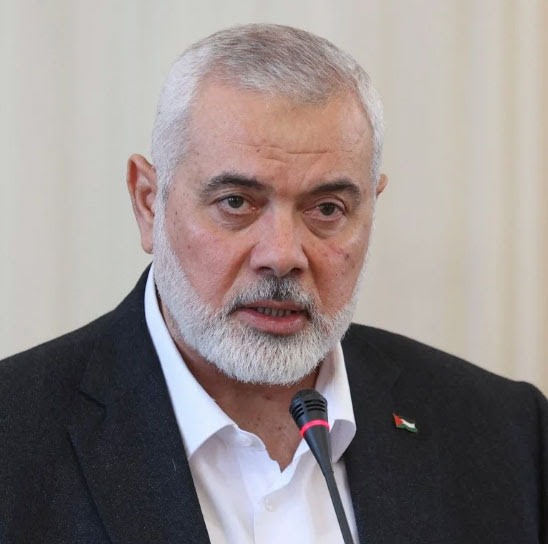
Ismail Haniyeh

Hours later, in Iran’s capital, Tehran, a direct missile hit Haniyeh’s residence, killing him and one of his bodyguards. [Image from South China Morning Post]

Iran and the militant Revolutionary Guard group immediately blamed Israel for the surprise assassination that risks escalation into an all-out regional war. Iran’s supreme leader vows revenge against Israel. Israel had pledged to kill Ismail Haniyeh and other Hamas leaders over the group’s October 7th attack on southern Israel that erupted into war in Gaza.

Meanwhile, Israel has not taken responsibility for Haniyeh’s assassination. Without mentioning Haniyeh’s death, Israeli PM, Netanyahu, proclaims that Israel “will exact a very heavy price from any aggression against us on any front.There are challenging days ahead.”

Israel often refrains from commenting on assassinations carried out by its Mossad intelligence agency or strikes on other countries.

Israeli Defense Minister Yoav Gallant has stated that Israel doesn’t want war despite killing the Hezbollah commander in Beirut, “but we are preparing for all possibilities.” He did not mention Haniyeh’s death.

Haniyeh left the Gaza Strip in 2019 and lived in exile in Qatar. Israel has targeted Hamas figures in Lebanon and Syria but targeting Haniyeh in Iran’s capital was vastly more involved, though Israel has operated there under cover in the past.

Following Haniyeh’s assassination, Iranian supreme leader, Ayatollah Ali Khamenei, declared that revenge was “our duty” and that Israel had “prepared a harsh punishment for itself” by killing “a dear guest in our home.” Iran’s Revolutionary Guard warned that Israel would face a “harsh and painful response” from Iran and its allies around the region. The Iranian Parliament held an emergency meeting later that day.

Hamas said Haniyeh’s assassination “takes the battle to a new level and will have major repercussions on the entire region.”

Khalil al-Hayya, a powerful Hamas figure formerly close to Haniyeh, said that Haniyeh’s replacement would “follow the same vision” regarding negotiations to end the war and continue the same policy of resistance against Israel.

Haniyeh’s killing creates the potential for direct confrontation between Iran and Israel should Iran choose to retaliate.

Israel and Iran – Bitter Enemies

Bitter enemies for years, Israel and Iran risked war earlier this year after Israel hit Iran’s embassy in Damascus in April. Iran retaliated by sending about 300 missiles and drones into Israel, most of which were intercepted by Israeli and Israeli allies’ defense mechanisms. Israel countered with an unprecedented strike on Iran’s facilities. However, international efforts succeeded in containing the violence before an all-out war broke out.

Besides direct retaliation on Israel, Iran could increase attacks through its proxies, the so-called “Axis of Resistance,” including Hezbollah, Hamas – mainly Shiite militias in Iraq and Syria – and Yemen Houthi rebels.

Netanyahu’s Response

Netanyahu declares that Israel will continue its war in Gaza until Hamas is totally eliminated. He asserts that Israel’s achievements in recent months are due to resisting pressure to end the war at home and abroad.

Hamas’ demand to end the war; to release a small number of abductees and to continue supplying weapons into Gaza while remaining in power is unacceptable to Netanyahu. Israel will never agree to demands that endanger its security; it would be a complete surrender to the terrorist group. Israel will continue fighting until complete victory is achieved, declares Netanyahu.

Please Pray

  • May all the plans of the enemy be null and void, in Yeshua’s name.
  • May the enemy’s traps be traps unto themelves.
  • May the enemy fall into each and every trap it prepares for Israel.
  • May confusion reign among Israel’s enemies. 
  • Please Lord, send Your warring angels to thwart each and every rocket thrown  at Israel.
  • May the God of Israel glorify His Name in bringing victory to Israel, His inheritance.  
  • Please continue to stand together with us for the protection of Israel from her surrounding enemies.
  • Father God, we worship You and thank you for giving the Israeli government and the army commanders wisdom and unity in making crucial decisions  during these challenging times.
  • Lift up in prayer the hostages in Gaza, the many thousands OF evacuees from their homes and the soldiers in line of duty and those in the reserves.
  • Father God, we thank You for drawing many Israelis to You during these war times(almost 10 months now)
  • We especially pray for the families who have lost loved ones, fathers, children, relatives and friends during the war.

Other image: Enormous Funeral for the 12 child victims of the bombing of a children’s soccer field in Madjal Shams. Photo from The Guardian

Filed Under: Conflict, From the Newsletter, SideBarStoryWidget-top Tagged With: Gaza, Hamas, Israel Threatened, Lebanon, Terrorism, War

  • Page 1
  • Page 2
  • Go to Next Page »

Primary Sidebar

  • Return to Home Page
  • Email

The Enemy Within

How Persia Became Iran

How Persia Became Iran Iran was known for centuries as Persia – a name originating from “Parsa”. However, this term was given by foreigners, not the people of the land itself. The indigenous people used the name “Iran,” a word that derives from “Airyam” which is a term found in the country’s ancient texts dating […]

The U.S. Administration – Friend or Foe of Israel?

May 12, 2024

"It will come about on that day that I will make Jerusalem a heavy stone for all the peoples; all who lift it will injure themselves severely. And all … [Read More...] about The U.S. Administration – Friend or Foe of Israel?

Recent Posts

  • The Jewishness of Christmas
  • Hamas in America
  • They Shall Come Back
  • The 20 Points of President Trump’s Peace Plan
  • Yom Kippur, The Day of Atonement

Categories

© MMXXV Yeshuatami, Ashdod ISRAEL