“Let everyone be subject to the governing authorities, for there is no authority except that which God has established…“
Romans 13:1
Posted: Dec 31, 2018
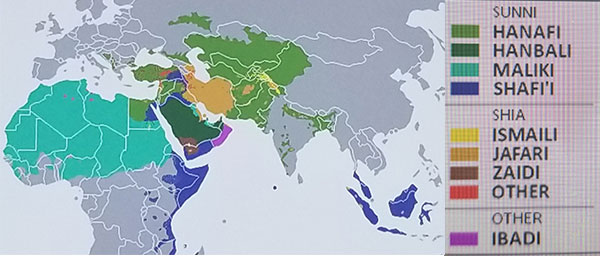
To understand the complexity of the situation in Syria, we have to understand that it is a war between the Sunni and Shi’a Muslims. [Click here to read more about who these Muslims are.] The Syrian war started at the time of the so-called Arab Spring in 2011 when protesters demanded the resignation of President Bashar al-Assad. His family, of the Shi’a Alawite-sect of Islam, has held the presidency in Syria since 1971. No one could have anticipated at that time the level of violence, trauma, and devastation that would result from that uprising for over seven years.
The conflict has been fought by different rebel groups and militias against the Assad regime, and against each other. With the rise of ISIS, It has expanded to include international powers such as Russia, Iran, some European nations and the United States.
Since then, Syria has been nearly destroyed, and the region was thrown into turmoil. Cities have been reduced to rubble by regime bombing, which had the far-reaching ramifications to nations around the world. Threats posed by terrorism, the migration crisis, and refugees. The number of casualties is too big to count, which is estimated at about half a million, and millions of refugees and internally displaced people, also too many to count.
The US started fighting ISIS in 2014. Much of the US operation in Syria has been waged by warplanes flying out of Qatar and other locations in the Middle East. After the airstrikes and increased fighting capacity of the allied ground forces, ISIS was degraded.
Fighting everyone all the time, ISIS lost their border areas, supply lines and communication, resources, and influence, they were finally driven from most of its territory in Syria’s north area.
In the beginning, then US president Barack Obama, assuming that Assad was going to fall anyway, took the side of the demonstrators and called on Assad to step down. However, Assad did not fall and didn’t step down. With the help of Russia, Iran, and Hezbollah, He is still on the winning side. Not wanting to risk direct conflict with the Russians, the US accepted the fact that they (the Russians) are there to stay.
Assad who has lost territory, men, resources, and independence has gotten weaker through the years of fighting, but is still stronger than any of his opponents and rivals.
 President Trump said that the United States was doing the work of other countries, including Russia and Iran, with little in return. He thinks it’s time others fight their own battles, and that US troops have no business in Syria since accomplishing their mission of helping fight ISIS.
Trump is true to his campaign promises to bring the 2,000 US troops back home. He wanted to do it earlier this year but gave in to his advisors not to pull the troops out of Syria before a peace agreement could be reached to end that country’s brutal civil war, and to keep them there to back up the Kurdish fighters and the Arab SDF militias (Syrian Democratic Forces) in their battle against ISIS.
However, this outraged NATO ally Turkey, which views Kurdish YPG forces as being an extension of a militant group fighting inside Turkey. [Click here to read more about the Kurds.] Turkey is still a key strategic ally of the US. In a phone conversation between Presidents Trump and Erdogan on Dec. 14, the Turkish leader promised that his army would not cross the Euphrates. Also during the course of their discussion, Erdogan reportedly agreed to cancel his order of the Russian S-400 surface-to-air missile system and to purchase a package of US Patriot missile systems valued at $3.5 billion instead.
Turkey’s planned purchase of the S-400 caused a rift between NATO member Turkey and NATO. The S-400 is not inter-operational with NATO systems. Turkish use of the system could endanger the American F-35’s stealth systems.
The White House announced that pulling US troops out of Syria does not mean that the Americans are leaving the coalition against ISIS, but rather, now that ISIS lost most of its strongholds, the White House is “transitioning to the next phase of the campaign.”
The US and Iraq are in advanced negotiations for the deployment to the Iraqi-Syria border of the Iraqi Special Operations Forces (ISOF) – which drove ISIS out of Mosul. It would position US troops 30km north of the Euphrates River and near the Syrian border. “We will be watching,” promised Trump.
The US is planning to build a permanent base, including an air force base on the Iraqi side of the strategic Tanif pass. This will allow them to control the area and prevent Shi’a militia to cross over into Syria. This way, the US will still control the situation without physically having boots on the ground in Syria.
As the Sunni rebels regroup, what Trump’s move would accomplish is bringing back the balance of the Sunnis against the Shi’as. With the defeat of 95% of Isis, the US can concentrate on the fight against Shi’a Iran, with the proxy of the Sunni rebels and the Sunni Turkish army. That means that Sunnis will enlarge their independent state in Syria around Haleb. Sunni rebels and the Turkish army are deploying forces all the time from all sides.
When Israeli PM Netanyahu’s decision to agree to a ceasefire with Hamas last month and not go to war, after Hamas fired about 500 missiles at Israeli cities in one day, he was criticized by most of Israelis, who saw this as an act of weakness. Netanyahu said at that time that there was more hidden than meets the eye, and not everything can be exposed to the public. Now we realize that what the army was planning was an operation to expose the tunnels of Hezbollah in the north and avoid a massive invasion from the terror group into Israel.
Likewise, with Trump’s decision to pull out the 2000 US troops. We don’t see or know all the considerations in that decision. It will be unfolding as time and events go on.
Israeli Prime Minister Benjamin Netanyahu said that U.S. President Donald Trump’s decision to withdraw American forces from Syria will not affect Israeli policy and that cooperation with the U.S. “will continue in full”. Israel will “continue to act against Iran’s attempts to entrench itself militarily in Syria, and to the extent necessary, we will even expand our actions there,” said Netanyahu.
We know that the Lord has this situation well in hand. Of course, there is always more going on than meets the eye. “He who keepeth Israel neither slumbers or sleeps.” Please continue to pray for those decision-making leaders and the ones who influence them both in Israel and in your country. And pray for the soldiers who face enemies every day and need to know the Keeper of Israel in a personal way.
For the salvation of Israel and the nations,
In His love,
Simcha and Bella Davidov, Ashdod, Israel
 In the 16th century, after prolonged wars, Kurdish-inhabited areas were split between the Safavid and Ottoman empires. From then until the aftermath of World War I, Kurdish areas (including most of Mesopotamia, eastern Anatolia, and traditionally Kurdish northeastern Syria) were generally under Ottoman rule. After the collapse of the Ottoman Empire, the Allies contrived to split Kurdistan among several countries. However, they were forced to accept Turkey’s conditions in the peace treaty. Turkey was willing to give up much of its empire’s territory in favor of setting new borders for the modern Republic of Turkey, which included parts of Kurdistan, leaving the Kurds without a self-ruled region. Other Kurdish areas were assigned to the new British and French mandated states of Iraq and Syria.