• Skip to primary navigation
  • Skip to main content
  • Skip to primary sidebar
  • Return to Home Page

Yeshuatami News Blog

All Things Israel

  • Conflict
    • Terrorism
  • History
    • Aliyah
    • End-time Prophecy
  • Politics
    • US
  • Israel
    • Holidays
    • Our People
  • From the Newsletter
    • Newsletter Archive
  • Give

Bella Davidov

Who Are the Kurds?

December 31, 2018 By Bella Davidov Leave a Comment

In the 16th century, after prolonged wars, Kurdish-inhabited areas were split between the Safavid and Ottoman empires. From then until the aftermath of World War I, Kurdish areas (including most of Mesopotamia, eastern Anatolia, and traditionally Kurdish northeastern Syria) were generally under Ottoman rule. After the collapse of the Ottoman Empire, the Allies contrived to split Kurdistan among several countries. However, they were forced to accept Turkey’s conditions in the peace treaty. Turkey was willing to give up much of its empire’s territory in favor of setting new borders for the modern Republic of Turkey, which included parts of Kurdistan, leaving the Kurds without a self-ruled region. Other Kurdish areas were assigned to the new British and French mandated states of Iraq and Syria.

In the 1970s, a group of radical Kurdish nationalist students led by Abdullah Öcalan in Turkey formed the militant group called Partiya Karkeren Kurdistan (PKK). PKK adopted the Marxist political ideology, with the goal of founding a separate independent, Marxist–Leninist state known as Kurdistan. The PKK fought an armed struggle against the Turkish state for cultural and political rights and self-determination for the Kurds in Turkey. PKK tactics were based on ambush, sabotage, riots, protests, and demonstrations against the Turkish government, and it has continued its guerrilla-type militant offensive for over thirty years. Turkey and the International community has listed PKK as a terrorist organization.

The YPG was formed in 2004 as the armed wing of the Kurdish leftist Democratic Union Party. It expanded rapidly in the Syrian Civil War. A sister group, the Women’s Protection Units (YPJ), fights alongside the YPG. The YPG is active in northern and eastern Syria.

In early 2015, the group won a major victory over ISIL (ISIS) at the Siege of Kobanî, where the YPG began to receive air and ground support from the United States and other coalition nations. Since then, the YPG has primarily fought against ISIL (ISIS), as well as on occasion fighting other Syrian rebel groups.

Several western sources have described the YPG as the “most effective” force in fighting ISIL(ISIS) in Syria. A light infantry force, the YPG has limited military equipment and few armored vehicles.

The YPG has been criticized by Turkey for its alleged support for the Kurdistan Workers’ Party (PKK), especially since a rebellion in southern Turkey began in 2015. Turkey has designated the YPG as a terrorist organization, and in 2018 Turkey captured most of the Afrin Canton area in Syria from the YPG.

Filed Under: From the Newsletter, History Tagged With: ISIS, Kurds, Syria

Pres. Trump Pulls Troops Out of Syria

December 31, 2018 By Bella Davidov Leave a Comment

Filed Under: Today Tagged With: Kurds, President Trump, Syria, US Troops

Threat From the North

December 22, 2018 By Bella Davidov Leave a Comment

“I will call upon the Lord, who is worthy to be praised;
So shall I be saved from my enemies.
(Psalm 18:3)

Soldier wiring a discovered Hezbollah tunnel for destruction.

Last week Israel discovered “terror tunnels” running from Lebanon directly into Israel by which  Hezbollah intended to sneak in terrorists “under our noses”.

Thank God, Israel destroyed the tunnels before they became operational.

Tensions have remained high on the northern border since the last war between Israel and Hezbollah in 2006 which lasted 35 days. It began when Hezbollah terrorists launched a raid into Israel, killing eight soldiers and kidnapping two others who also died.
Israel warned Hezbollah not to interfere with the tunnel demolition or face the Israeli Defense Force’s (IDF) massive military force.

Hezbollah, in turn, threatened to attack Israel with its vast rocket arsenal.
The first tunnel the IDF discovered started in a Lebanese civilian home and was at least 200m (650ft) long, running 40m inside Israel near the border town of Metulla. (At that time the area was declared a closed zone.) The second tunnel was discovered close to that area and two others were found shortly afterward.

In the opinion of an Israeli army colonel, the tunnels were part of a plan by Hezbollah to “conquer the Galilee” region of Israel in a future conflict.

Imagine; had Israel not discovered those tunnels, thousands of hate-filled terrorists would have emerged from them directly into northern Israel, storming the homes of unsuspecting Israelis. Men, women, and children would have been massacred and many taken hostage. Waiving flags victoriously, Hezbollah terrorists would yell “Allah Akbar” and “we have liberated the Galilee.” And should Israel respond, Hezbollah would fire thousands of long-range missiles into every part of Israel.

Soldier using equipment to search for tunnels.

Thank God for “Operation Northern Shield,” launched Dec. 4th whereby Israel foiled the plans of the enemy. Israeli intelligence collected data over a span of four years and the hi-technical engineering army unit developed ways and means to detect and destroy dozens of tunnels along the common border.

This impressive operation, in cooperation with high-ranking army commanders, intelligence units and members of the political echelon was planned out in secrecy for four years until the day of the operation in order to ensure the ability to catch the enemy by surprise. This is a miracle in itself.

Hezbollah, a Shi’a Islamist militant organization and political party based in Lebanon headed by Hassan Nasrallah, does not recognize Israel’s right to exist and has been accused of carrying out a string of bombings and plots against Jewish and Israeli targets around the world over decades. Israel has also reportedly carried out killings against Hezbollah figures.
Hezbollah has built up an extensive arsenal since the 2006 conflict, possibly possessing up to 150,000 rockets.

Israel has said it will not allow Hezbollah to obtain advanced missiles and frequently carries out airstrikes on arms being transferred to the organization through Syria.

Tension on the Lebanese Border

The situation is very delicate and can spark an eruption, if not treated carefully. Soldiers on both sides of the “Blue Line,” bordered with concertina wire separating them are within touching distance. The “Blue Line” is the demarcation between Lebanon and Israel set by the UN after the end of the 2006 war.

Lebanese soldiers rushed to the point of conflict on Monday after Israeli troops rolled out barbed wire along the border, protesting that the wire was placed on their side of the border.
The Israeli army said the wire was installed entirely in Israeli territory, in coordination with UN peacekeepers. Both Israeli and Lebanese soldiers are so close that even a small incident can cause an explosion. Israeli backup soldiers are on watch to make sure Hezbollah terrorists are not hiding anywhere close, trying to interrupt or sabotage Israeli efforts. It is a very volatile situation. An IDF statement said, “Operations along the border continue as planned, both on overt and covert levels.”

Proof to the World

On the diplomatic level, Israel succeeded in proving to the world the schemes of its enemy to the north – Hezbollah. Even CNN sent one of its own cameras down into the tunnel to document the plans of Hezbollah against Israel. On Tuesday, the IDF Spokesperson’s Unit put out an English-language video aimed at the international community showing the danger Hezbollah presents not just to Israel but also to the citizens of Lebanon.

[Film from newscast, video will have English speaking in the middle]

UN Interim Forces in Lebanon, who were called to the site, confirmed that two of the tunnels cross the Blue Line. “These constitute violations of U.N. Security Council Resolution 1701″ (by Hezbollah).

Israel has called on the international community to impose new sanctions on the Iranian-backed Hezbollah, the heavily armed mini-army with an arsenal of some 130,000 of rockets that can reach nearly every part of Israel.

PM Netanyahu, during a tour of the northern border, said: “we shall totally nullify the Hezbollah tunnel threat.” Israeli officials have indicated that the IDF may operate within Lebanese territory, if necessary, to destroy the tunnels.

Israel holds the Lebanese government responsible for the tunnels being dug inside its territory. Lebanese President Michel Aoun, a Hezbollah ally, said Tuesday that the United States assured him that Israel has “no aggressive intentions” with its Operation Northern Shield.

The IDF will construct an access to the first Hezbollah terror tunnel near Metula as a model. It will become a site for diplomats and foreign correspondents to visit and see with their own eyes (and cameras) what Israel has discovered. [Read More About Hezbollah]

Please pray for our leadership to have Godly wisdom and strength in facing of these issues. Please stand with us in faith on the promises and Word of God. We know that the God is Israeli’s protector. He never slumbers nor sleeps. Please pray with us for the people of Israel, asking God to open the eyes of the hearts of many as they are looking for help from men. May many realize that God is our Helper.

We love and appreciate you very much. We would love to hear from you – any comments, questions and/or prayer requests. Again we would like to thank you for your prayers and financial support. We pray for you too from Zion, for God to supply all your needs and bless you greatly.

For the salvation of Israel and the nations,
In His love,
Simcha and Bella Davidov, Ashdod, Israel

Filed Under: Conflict, Newsletter Archive, Politics

Hezbollah

December 21, 2018 By Bella Davidov Leave a Comment

A Brief Background

After the British mandate left Palestina in 1947, (a name given to the land of Israel by the conquering Romans), the Arabs refused to divide the land and attacked the Jews in the land from all sides. Against all odds, Israel won the war of Independence and became a nation in 1948. The name of the land was changed back to the land of Israel and Jewish citizens to Israelis instead of Palestinians (all people living in the land before 48 were called Palestinians, Jews and Arabs.) Many Arabs fled in the war to neighboring countries, mainly Jordan and Egypt.

Lebanon was at that time multi-sectarian, with Sunni Muslims and Christians being the majorities in the coastal cities, Shia Muslims in the south and east, and Druze and Christian in the mountains. The Lebanese government operated under the influence of the elites Maronite Christians and the western world. However, the Muslims opposed the western influence of the government.

The Palestinian Arabs formed the PLO (Palestine Liberation Organization) and Fatah brigade to fight Israel.

After the six-day war with Israel, Jordan lost the West Bank and allowed Fatah under the PLO and their leader, Yasser Arafat, into the country from where they stepped up their guerrilla attacks against Israel. However, after many fights with the PLO who turned against the Jordanian leadership, they were expelled to southern Lebanon along with Yasser Arafat, where they regrouped.

The enlarged PLO presence in Lebanon and the intensification of fighting on the Israeli–Lebanese border stirred up internal unrest in Lebanon. The PLO recruited militants from among the families of Arab Palestinians who had fled to Lebanon during the Israeli independence war.

Demographic tensions over the Lebanese National Pact led to the Lebanese Civil War (1975–1990) where militia clashed with Palestinian factions over their terror attacks against Israel from Lebanese territory.

A PLO terror attack on March 11, 1978, was the last straw for Israel. An Israeli bus was seized by terrorists, and 38 Israeli civilians including 13 children were killed, with 76 wounded. The Israeli air force, navy, and land units entered south Lebanon with the aim of capturing the strongholds of the terrorist groups. Heavy face-to-face fighting resulted in Israel taking over the south Lebanon region, 300 terrorists were dead and many civilians fled to northern Lebanon, among them many terrorists. Israel suffered 18 dead soldiers.

Eventually, Israel withdrew back to the original border. UNIFIL units were stationed in the demilitarized zone. Another force, the Christian militia who were favorable to Israel and were supported by the Israeli army, formed the army of south Lebanon there.

However, terror attacks continued now from northern Lebanon which fired Katyusha rockets and missiles into northern Israel. Simultaneously, Israeli and Jewish targets were hit around the world. The situation became unbearable, forcing Israel to launch another large-scale military operation in 1982.

This new operation, called “Peace in Galilee” targeted the terror organizations who had returned to southern Lebanon. Heavy fighting broke out between the Israeli army and PLO terrorists who also had headquarters in Beirut. Many Katyusha rockets were fired into northern Israeli northern population. Israeli paratroopers fought terror pockets in villages along the road from the border to Beirut.

The Israeli army got tangled up in the Lebanese war against thousands of terrorists who were hiding in densely populated areas with the help of the Syrian army. The result was the defeat of the Syrian army, the death, and capture of many terrorists and much ammunition being taken by Israel. The PLO was expelled from Lebanon, including Arafat who fled to Tunisia.

Israel withdrew from most of Lebanon in 1985 but kept control of a 12-mile security buffer zone, held with the aid of proxy militants of the South Lebanon Army (SLA). Israel suffered many losses, about 1200 soldiers died in the first Lebanon war between the years 1982-2000. The war also resulted in the surfacing in south Lebanon of another terror organization, Hezbollah.

Eventually, the Israeli army had to withdraw also from the militarized zone in southern Lebanon in 2000.

The Rise of Hezbollah

Hezbollah, which means in Arabic “Party of Allah”, is a Shi’a Islamist militant organization and political party based in Lebanon headed by Hassan Nasrallah. Hezbollah, along with its military wing is considered a terrorist organization by the United States, Israel, Canada, the United Kingdom, Australia, and the European Union.

Following the Islamic revolution in Shīʿite Iran in 1979 and the Israeli operation in Lebanon in 1982, a group of Lebanese Shīʿite clerics formed the Hezbollah organization, which holds to an extreme Shīʿite ideology with three main aims: Jihad (holy war) against all foreigners in Lebanon, the destruction and annihilation of Israel; and spreading the Islamic revolution and turning Lebanon into another Islamic republic like Iran. Since its beginning, Hezbollah organization considers Israel an enemy and never refers to it by its name but rather calls it “occupied Palestine,” or the “Zionist enemy.”

Hezbollah organization uses guerrilla and terror warfare in order to achieve its goals. It promotes suicide bombing, kidnappings, car bombings and grand terror attacks around the world and against foreigners in Lebanon, which gives other terror organizations inspiration to do the same. Hezbollah was based in the predominately Shīʿite areas in southern Lebanon, and southern Beirut. Throughout the 1980s, Hezbollah engaged in attacks against Israel and fought in Lebanon’s civil war (1975–90). It also worked at establishing a comprehensive social services network for its supporters.

Being a proxy of Iran and Syria, Hezbollah remained a militia organization after the end of the Lebanese civil war In May 1991, when the other militias were dissolved and continued to fight a sustained guerrilla campaign against Israel in southern Lebanon.

After the Israeli army withdrew from the militarized zone in southern Lebanon in 2000, Hezbollah took control over the area, with the help of Syria and Iran. It built many headquarters and strongholds, built military infrastructures, and a massive missile and rocket arsenal. Hezbollah members were trained in progressive fighting techniques by Iranian military and intelligence personnel, who helped build bunkers across the Israeli border in South Lebanon, and assisted in forming command headquarters and control and surveillance systems within the organization’s headquarters in southern Beirut.

On July 12th, 2006, Hezbollah executed a preplanned artillery attack across the Israeli northern border. They ambushed two Israeli patrol vehicles, killing three Israeli soldiers, wounding two and kidnapping two.

IDF (Israeli Defense Force) began a war against Hezbollah with an aerial attack on thousands of targets within Lebanon: Hezbollah’s rocket system, Hezbollah posts, arms storages, training camps, command headquarters, Beirut Airport, and bridges. The Israeli Air Force dropped pamphlets calling Lebanese citizens of settlements in southern Lebanon to evacuate their homes.

Hezbollah began firing hundreds of rockets towards populated areas in Israel. The citizens of Haifa and northern Israel had to reside in shelters and protected areas. On July 14th, Hezbollah fired at an Israeli missile boat, in which four naval soldiers were killed. The war escalated into massive attacks and crackdowns on all terrorists who were hiding in civilian facilities.

In the 33 days of the war, there were 164 Israeli citizen casualties (119 soldiers and 45 civilians) and hundreds injured. Approximately 4,000 rockets hit the north of Israel and significant economic damages were incurred. Hezbollah had also lost hundreds of its members and the organization’s strategic fighting ability was hurt. Its headquarters in South Beirut were destroyed.

On August 11th, the United Nations’ Security Council issued a resolution calling for “a complete halt of acts of aggression, and especially those committed by Hezbollah and the military actions of Israel.”

The UN resolution called for the withdrawal of the Israeli Defense Force from Lebanon and for the South Lebanon Army and UNIFIL to take control over the south Lebanon area, prohibition of carrying arms without the consent of the Lebanese government; and the prohibition of the trade or transfer of arms to Hezbollah. Lebanon had to see to the disarmament of armed militias and the unconditional release of the Israeli soldiers imprisoned.

Somehow Hezbollah and its leader, Hassan Nasrallah, emerged from the war with Israel as heroes throughout much of the Arab world. Hezbollah used its new position to attempt to topple Lebanon’s government after its demands for more cabinet seats were denied.

In May 2008, clashes between Hezbollah forces and government supporters in Beirut were sparked by government decisions that included plans to dismantle Hezbollah’s private telecommunications network. Nasrallah saw it as a declaration of war and mobilized Hezbollah forces, which quickly took control of parts of Beirut. In the following days the government reversed its decisions and granted the Hezbollah-led opposition the desired veto power.

A wave of popular uprisings in early 2011, known as the Arab Spring left Hezbollah in a difficult position. After applauding revolutionary movements in Tunisia, Egypt, Libya, and Bahrain, the group found its interests threatened by a similar movement against its key ally, Syrian Pres. Bashar al-Assad. As protests spread throughout Syria and the civilian death toll mounted, Nasrallah spoke out in support of Assad, echoing Assad’s denunciations of the Syrian opposition as being agents of a foreign conspiracy. The conflict soon escalated into a full-blown civil war.

Since 2012, Hezbollah has helped the Syrian government during the Syrian civil war in its fight against the Syrian opposition, which Hezbollah has described as a Zionist plot and a “Wahhabi-Zionist conspiracy” to destroy its alliance with Assad. It had deployed its militia in both Syria and Iraq. Nasrallah publicly confirmed Hezbollah’s involvement and vowed to fight until the rebels had been defeated.

On May 6, 2018, Lebanon held its first legislative election since 2009. Hezbollah got a politically dominant position in the government for the first time. Top-level positions in the parliament nonetheless remained the same, including Hariri as prime minister.

Hezbollah has been described as a “state within a state”, and its military strength has grown significantly with its military wing that is now considered more powerful than the Lebanese Army. The organization has seats in the Lebanese government, a radio and a satellite TV station, social services and large-scale military deployment of fighters beyond Lebanon’s borders, Hezbollah receives military training, weapons, and financial support from Iran, and political support from Syria.

Filed Under: Conflict, From the Newsletter, History, Terrorism Tagged With: Hezbollah

Hanukkah Miracles, Then and Now

December 7, 2018 By Bella Davidov Leave a Comment

“Who is like You, O Lord, among the gods? Who is like You,
glorious in holiness, awesome in praises, doing wonders?” Ex. 15:11

Shalom Dear Friend and Prayer Partner, Happy Hanukkah.

Hanukkah (dedication) is a holiday of miracles. It commemorates the miraculous victory of the small army of brave Jews over the much larger and better-equipped Syrian/Greek army and the liberation of the Holy Temple in Jerusalem from the hands of the pagan ruler Antiochus Epiphanes. [Read more about the historical account of Hanukkah in our blog.]
One of the benedictions Jews say when lighting the candles of the Hanukiah (Hanukkah candelabra) is: “We light the candles for the miracles that You have done for our forefathers in days of old, and are still doing today.”

There is a top (called a dreidel) that children use to play a game during the holiday. The top has four sides. On each side there is a Hebrew letter that represents the sentence, “Nes Godol Haya Poe,” which means, “a great miracle happened here.” In all the wars Israel had to fight against surrounding enemy neighbors, there were many miracles that enabled the tiny nation to survive and thrive. Presently Israel is facing fierce and violent enemies from the north and the south, whose aim is to wipe Israel off the map of the Middle East.

The following accounts are two recent incidents that are viewed as miracles that happened on the Gaza border this year close to the time of Hanukkah.

Lt. Bar Vaknin

Lt. Bar Vaknin of Israeli’s elite Givati Brigade was shot in the stomach by a Hamas sniper a few months ago, he said he was, “saved by a miracle.”

Gazan crowds burn tires, so clouds of smoke prevent the Israeli guards from seeing their actions.

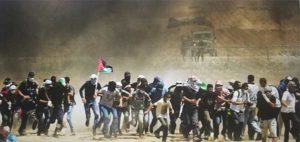
Lt. Vaknin was stationed on the security fence, separating Israel from Gaza, protecting Israel from the Hamas-led ‘March of Return’ that has brought tens of thousands of Gazans, including old men, women, and children to violently riot along the border every Friday. For eight months crowds of Gazans have stormed the border fence, throwing explosives, firebombs, and rocks at Israeli soldiers. They flew many kites with flaming objects attached with the goal of damaging the fence and other Israeli targets (many Israeli fields nearby were burned to the ground.) They burn tires, so clouds of smoke prevent the Israeli guards from seeing their actions. Youth tug at barbed wire along the fence to cut it and go through into Israel.

Vaknin saw a group of children at his section of the fence who began to approach the border. He fired several warning shots in the air to disperse the crowd. Suddenly he felt an explosion in his stomach when a Palestinian Hamas sniper shot him. “I fell backward down the embankment. The first thing I did was to call on the radio while I was still falling.’’ They rushed him to the hospital and operated on him. “I am so thankful for my comrades’ quick reaction”. He considers it “a miracle.”  Vaknin was released from the hospital but faces a long period of rehabilitation.

Bus Bombing

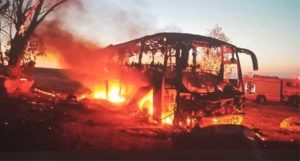
The other miracle happened on the evening of November 12, just before Hamas fired about 500 rockets at nearby Israeli areas, including the city of Ashkelon that suffered most of the hits. A Kornet anti-tank guided missile (they are very precise) was fired from the Gaza Strip at an Israeli bus just several kilometers from the Gazan border. The precise hit caused the bus to explode and burn.

Just minutes before the bus suffered the direct hit, it had dropped off some 50 Israeli soldiers. The Hamas terror group had stalked the bus for several minutes until it was fully exposed to them from the Strip. Only then did they fire the missile, hitting the bus and setting it on fire. The soldiers didn’t know it when they left the bus, but God knew. These few minutes were the miracle that saved their lives. The burning bus was empty.

One 19-year-old Israeli soldier was severally injured while he stood next to the bus. He was taken to Beersheba’s hospital in life-threatening condition and successfully underwent emergency surgery. The Arab bus driver was also taken to the hospital suffering from shock. Later on, he told doctors at the Beersheva hospital that it was a “miracle” that the soldiers on his bus were not killed and that the incident proves that “God loves the Jews.” He said: “I just let off 50 soldiers from the bus. A minute later the bus was hit. [if it was] 60 seconds earlier you would have had 50 dead soldiers.”

We thank and praise the Lord, God of Israel for His awesomeness, for He is good and His mercies endure forever. Please continue to pray for Israel’s protection.

       We love and appreciate you very much. We would love to hear from you – any comments, questions and/or prayer requests. Again we would like to thank you for your prayers and financial support. We pray for you too from Zion, for God to supply all your needs and bless you greatly.

For the salvation of Israel and the nations,
In His love,
Simcha and Bella Davidov
Ashdod, Israel

Filed Under: Holidays, Newsletter Archive

  • « Go to Previous Page
  • Page 1
  • Interim pages omitted …
  • Page 14
  • Page 15
  • Page 16
  • Page 17
  • Page 18
  • Interim pages omitted …
  • Page 26
  • Go to Next Page »

Primary Sidebar

  • Return to Home Page
  • Email

War

They Shall Come Back

And they shall come back from the land of the enemy. There is hope in your future, says the Lord, your sons shall come back to their own border.  Jeremiah 21:16b-17 This happened today, Monday October 13. Exactly two years ago, on the Holiday of Succot (booths), Hamas brutally attacked southern Israel from Gaza, murdering 1,200 Israelis and abducting 251 into […]

U.S. President Trump’s Epic Fury -Where Is It Going?

March 26, 2026

"אַרְיֵה שָׁאָג מִי לֹא יִירָא " "The lion has roared, who will not fear?..." Amos 3:8a The world is trying to understand President … [Read More...] about U.S. President Trump’s Epic Fury -Where Is It Going?

Recent Posts

  • Best Allies
  • U.S. President Trump’s Epic Fury -Where Is It Going?
  • Israel at War with Iran – Operation Roaring Lion
  • The Jewishness of Christmas
  • Hamas in America

Categories

© MMXXVI Yeshuatami, Ashdod ISRAEL