• Skip to primary navigation
  • Skip to main content
  • Skip to primary sidebar
  • Return to Home Page

Yeshuatami News Blog

All Things Israel

  • Conflict
    • Terrorism
  • History
    • Aliyah
    • End-time Prophecy
  • Politics
    • US
  • Israel
    • Holidays
    • Our People
  • From the Newsletter
    • Newsletter Archive
  • Give

History

610 CE The Rise of Islam

June 20, 2017 By Bella Davidov Leave a Comment

A map showing the spread of Islam.

In 610 CE Muhammad started preaching publicly in Saudi Arabia about revelations he believed he received from the angel Gabriel in a cave. He proclaimed to the pagan-idol-worshipping Arabs that “God is One” and that complete “surrender” (“Islam” in Arabic) to him is the “din” (the law). He proclaimed that he was a prophet and messenger of God. In 622 CE Muhammad and his few followers met opposition, hostility, and persecution from some of the tribes in Mecca and they migrated to Medina. This event, the Hijra, marks the beginning of the Islamic calendar, also known as the Hijri Calendar. In Medina, Muhammad was able to unite the tribes after eight years of conflict with the Meccan tribes. In December 629 CE Muhammad and his army of 10,000 Muslim converts attacked and conquered Mecca. Under his leadership also Persian troops were defeated and withdrew from the occupied Byzantine eastern provinces. Before Muhammad’s death in 632 CE, most of the Arabian Peninsula had converted to Islam.

Muhammad was succeeded by Abu Bakr, the first Caliph with undisputed control of the entire Arab peninsula after successful wars, which resulted in the consolidation of a powerful Muslim state throughout the peninsula.

The Muslim Arab army attacked Jerusalem, held by the Byzantine Romans, in November, 636 CE. After four months of siege, the Orthodox Patriarch of Jerusalem, Sophronius, agreed to surrender Jerusalem to Caliph Umar in person. Caliph Umar who was at that time in Medina agreed and traveled to Jerusalem to sign the capitulation in the spring of 637 CE. They made an agreement allowing religious freedom for Christians in exchange for a tax to be paid by the conquered non-Muslims, which included the Jewish population of Jerusalem, who, as a result of the agreement, enjoyed a certain amount of religious tolerance.

The Temple Mount

At the time of the Muslim conquest, the Temple Mount was the site of an elaborate Byzantine church. (The remains of an elaborate mosaic floor were discovered in the 1930s by the British Mandate Antiquities Department).

In 682 CE, 50 years after Muhammad’s death, Abd Allah Ibn al-Zubayr rebelled against the Caliph of Damascus, conquered Mecca and stopped pilgrims from coming south to the Hajj in Mecca. Abd al-Malik, the Umayyad Caliph, responded by creating a new holy site. He interpreted sura 17, verse 1 in the Koran that describes Muhammad’s traveling in a night dream “from the Sacred Mosque to the Farthest Mosque” as the latter being the mosque on the Temple Mount in Jerusalem.

Abd al-Malik started construction of the Dome of the Rock on the Temple Mount in 687 CE and it was completed in 691/2 CE by his son and successor Al-Walid I. It was built on the site of the historic Jewish Temple that was destroyed twice (the last time by the Romans in 70 CE). Historians commonly accept the Jewish background of the site of the construction of the Dome of the Rock. According to historians, Abd al-Malik built the shrine in order to “compete in grandeur” with Jerusalem’s monumental churches.

The al-Aqsa mosque was built at the southern end of the Mount in the 8th-century.

With the Arab Islamic Caliphate conquest of Jerusalem, Jews were allowed back into the city. While the majority population of Jerusalem during the time of Arab conquest was Christian, the majority of the population of Palestine (Jews, Christians, and Arabs who lived in Palestine were called Palestinians) about 300,000-400,000 inhabitants was still Jewish. A massive immigration to Palestine by Arab Muslims resulted in the adoption of the Arabic language and conversion to Islam by part of the local population.

The caliphs of Damascus (661–750 CE) were tolerant princes who were generally on good terms with their Christian subjects. Many Christians held important offices at their court. Also the Abbasid caliphs at Baghdad (753–1242 CE), as long as they ruled Syria, were tolerant of Christians.

Rival dynasties and revolutions tore the Muslim world, while the Byzantine Romans continued to attempt to regain their lost territories, including Jerusalem. Christians in Jerusalem who sided with the Romans were put to death for high treason by the ruling Muslims. In the 9th century, Palestine was conquered by the Fatimid dynasty of North Africa. The Fatimid ruler expelled the native Christian population. Palestine once again became a battleground as the various enemies of the Fatimid dynasty attacked. The sixth Fatimid caliph, Caliph Al-Hakim (996–1021 CE), who was believed to be “God made manifest” by the Druze, destroyed the Church of the Holy Sepulchre in 1009 CE. By early June 1099 CE, Jerusalem’s population had declined from 70,000 to under 30,000.

At that time, a large Jewish community existed in Ramle and smaller communities inhabited Hebron and the coastal cities of Acre, Caesarea, Jaffa, Ashkelon and Gaza. Under Islamic rule, the rights of Jews and Christians were reduced and they could reside only by payment of the special tax. Documents from 1015 and 1080 CE attest to a significant Jewish community in Rafah (in the Gaza strip).

Between the 7th and 11th centuries Masoretes (Jewish scribes) in the Galilee and Jerusalem were active in compiling a system of pronunciation and grammatical guides for the Hebrew language. They authorized the division of the Jewish Tanakh (Old Testament of the Bible) known as the Masoretic Text, which is still regarded as authoritative today.
[Next: Read about the Crusaders]

Filed Under: History

1099 CE Under Crusader Rule (1099–1291)

June 20, 2017 By Bella Davidov Leave a Comment

The First Crusade was anti-Jewish, with the goal of “subjugating all non-believers to the [Christian] faith” by forced conversions. In order to avoid such conversions, there are records of cases of mass suicides within Jewish communities, particularly among Jewish virgins. The Crusaders left trails of bloodshed in Europe on their way to ‘liberate’ the Holy Land. In Palestine, both Muslims and Jews were indiscriminately massacred or sold into slavery. The records from 1099 to 1291 CE state that the Christian Crusaders, “mercilessly persecuted and slaughtered the Jews of Palestine” forcing Jews to convert on the threat of death. Under Crusader rule, Jews were not allowed to own land or involve themselves in commerce.

In 1099 CE Jews were among the rest of the population who tried in vain to defend Jerusalem against the Crusaders. When the city fell, a massacre of 6,000 Jews occurred when the synagogue they were seeking refuge in was burned. In Haifa, the Jews and Muslims held out for a whole month (June–July 1099 CE).

At this time there were Jewish communities scattered all over the country, including Jerusalem, Tiberias, Ramleh, Ashkelon, Caesarea, and Gaza. A large volume of piyutim (worship poetry) and Midrashim (teachings) originated in Palestine at this time. In 1165 CE Maimonides visited Jerusalem and prayed on the Temple Mount, in the “great, holy house”. In 1141 CE Spanish poet Yehuda Halevi issued a call to the Jews to immigrate to the Land of Israel, a journey he undertook himself.

[Next: Read about Saladin]

Filed Under: History

1187 CE Jerusalem is Conquered by Saladin

June 20, 2017 By Bella Davidov Leave a Comment

Saladin was the first sultan of Egypt and Syria and the founder of the Ayyubid dynasty. A Sunni Muslim from Kurdistan, Saladin led the Muslim military campaign against the Crusader states in the Middle East. At the height of his power, his sultanate included Egypt, Syria, Upper Mesopotamia, the Hejaz, Yemen and other parts of North Africa.

Under Saladin’s command, the Ayyubid army defeated the Crusaders at the Battle of Hattin in 1187 CE and gained control of Palestine from the Crusaders, including the city of Jerusalem, which was conquered by the Crusaders 88 years earlier. Although the Crusader Kingdom of Jerusalem continued to exist until the late 13th century, its defeat at Hattin marked a turning point in its conflict with the Muslim powers of the region.

In time, Saladin issued a proclamation inviting all Jews to return and settle in Jerusalem. There were 6 more Crusades and they all ended in defeat.

In 1211 CE, the Jewish community in the country was strengthened by the arrival of a group of European Jews, including over 300 rabbis from France and England, who immigrated to the Holy Land, motivated by persecution, economic hardship, messianic expectations or the desire to fulfill the commandments specific to the land of Israel. The Spanish Jewish pilgrim Judah al-Harizi found the sight of the non-Jewish structures on the Temple Mount very disturbing: “What torment to see our holy courts converted into an alien temple!” Nachmanides, the 13th-century Spanish rabbi, wrote: “If the gentiles wish to make peace, we shall make peace…but as for the land, we shall not leave it in their hands, nor in the hands of any nation, not in any generation.”

[Next: Read about the Mamluks]

Filed Under: History

1250 CE The Mamluks

June 20, 2017 By Bella Davidov Leave a Comment

The Arab rulers, who ruled Palestine purchased Christian children, converted them to Islam and trained them to be soldiers. They became the Arabs’ slave soldiers. These slave soldiers are called Mamluks, which means in Arabic “owned”. In 1250 CE, The Mamluks rebelled against their Arab masters. They won control of Egypt, Syria, and Palestine. They established their capital in Damascus. Under their rule, Jews and Christians suffered greatly. Jews were heavily taxed. There were also riots in which many Jews were killed. Synagogues were destroyed and Jews were forced to wear a distinctive yellow turban. Other Nazi-like dress codes were also imposed. Jews and non-Jews were forcibly converted to Islam. Heavy taxes were imposed on Jews in Jerusalem and many had to leave the city because they couldn’t afford to pay them.

At that time Palestine became the frontier of Mongol invaders (occasional Crusader allies). The conflict impoverished the country and severely reduced the population. Sultan Qutuz of Egypt eventually defeated the Mongols and his successor (and assassin), Baibars, eliminated the last Crusader Kingdom of Acre in 1291 CE, thereby ending the Crusader presence.

In 1266 CE the Mamluk Sultan Baybars converted the Cave of the Patriarchs in Hebron into an exclusive Islamic sanctuary and banned Christians and Jews from entering. Previously Christians and Jews had been able to enter it for a fee. (The ban remained in place until Israel took control of the building in 1967.)

In 1438, Italian Rabbi Elijah of Ferrara settled in Jerusalem and became a lecturer and dayyan (Judge). In 1440, Rabbi Ovadiah of Bertinoro became the spiritual leader of Jerusalem’s Jews. He found the city forsaken with only about seventy poor Jewish families. His guidance brought better conditions. The excessive taxes against Jews were abolished. Also during this time Jewish refugees from Spain fleeing from the Spanish Inquisition immigrated to the city. By 1495 the populations of the city had swelled to 200 families. Ovadiah initiated the rejuvenation of Jerusalem’s Jewish community.

In 1455 a large group of prospective emigrants from across Sicily were arrested for attempting to sail to Palestine and accused of planning to illegally smuggle gold off the island (the authorities were against the mass emigration of Jews because they didn’t want to forfeit revenue made from special Jewish taxes). After nine months of imprisonment, a heavy ransom freed 24 Jews who were then granted permission to travel to Palestine so long as they abandoned all of their property.

Joseph Saragossi who arrived in the closing years of the 15th century in Safed developed the city into the largest concentration of Jews in Palestine. With the help of the Sephardic immigration from Spain, the Jewish population increased to 10,000 by the early 16th century. Twenty-five years earlier there were just 300 families in and around Safed. The first record of Jews in Safed was provided by French explorer Samuel ben Samson 300 years earlier, in 1210, when he found only 50 Jews in residence. At the beginning of the 17th century, Safed was to boast eighteen Talmudic colleges and twenty-one synagogues.

According to records, there were at least 30 Jewish urban and rural communities in the country at the opening of the 16th century.

In 1516, Palestine was conquered by the Turks and became a part of the Ottoman Empire.

[More info to come soon]

Filed Under: History

Names (Part 1): God Changes Names – Man Changes Names

June 10, 2017 By Bella Davidov Leave a Comment

God-Elohim has many names. When Moses asked Him what His Name is, so he could tell the people of Israel that this is  Who sent him, God replied: “I will be whoever I will be, אהיה ‬‬‬אשר אהיה (future tense). He calls Himself ‫יהוה‬ (Yehova, Was, Is and Is To Be). In the first name the letter ‫ה ‬ (H) appears four times, in the second it appears twice. When God changed Abram’s name ‫אברם ‬ (high father) to ‫ אברהם ‬ AbraHam, He added the letter ה (H) meaning father of many nations. In the same way, He changed Abraham’s wife’s name Sarai to SaraH  ‫ה‬.‬‬‬‬‬‬‬

There was a reason for both name changes. It was so that they would know that He has a purpose for the two of them as mother and father of the son of promise. However, by the time God gave Abraham the promise that his seed would be as the stars and sand (Gen. 15:5,) and that through him all of the nations of the earth would be blessed, Abraham and his wife Sarah were too old to have children. Sarah gave her Egyptian maid Hagar to her husband Abraham to be the surrogate mother of their future heir, and Ishmael was born. But he was not the Son of the Promise.

Abraham fell on his face and laughed when God told him that Sarah would bear him a child. Abraham said to himself: “Will a son be born to a man a hundred years old? Will Sarah bear a child at the age of ninety?” And Abraham said to God, “If only Ishmael might live under your blessing!” (Gen. 17:17-18)

God made it clear to Abraham that Isaac, not Ishmael was the Son of the Promise:
Then God said, “Yes, but your wife Sarah will bear you a son, and you will call him Isaac (will laugh – in Hebrew). I will establish my covenant with him as an everlasting covenant for his descendants after him. And as for Ishmael, I have heard you: I will surely bless him; I will make him fruitful and will greatly increase his numbers. He will be the father of twelve rulers, and I will make him into a great nation. But my covenant I will establish with Isaac, whom Sarah will bear to you.“

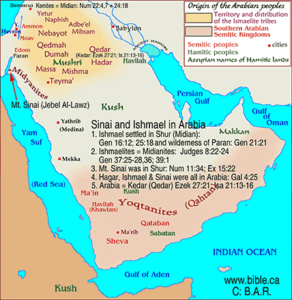
Just as the Lord had said, a year later Sarah gave birth to Isaac. God told Abraham to send Ishmael away (he settled in Paran in Arabia,) that He would make him there a great nation also:
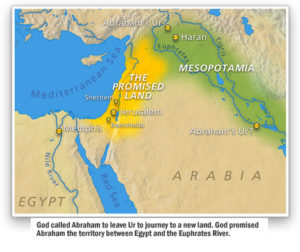
God said to Abraham, “Do not be grievous because of the boy (Ishmael) and because of your slave woman…For from Isaac will your seed be called.” (Gen. 21:12)

So two great nations came out of Abraham; the Arabs from Ishmael (not the Seed of the Promise) and Israel, from Isaac – the Seed of the Promise.
[Read more about the Promise on our Blog]

Where does the name Israel come from?

The name “Israel” comes from the Hebrew words Isra (verb meaning to wrestle) and El (meaning God). Genesis 32:24-30:
“And Jacob remained alone (all night). A man fought with him until daybreak. When the man saw that he could not prevail, he struck Jacob on the hip and threw it out of joint. The man said, “Let go of me! It’s daylight.” And he said: “I will not let you go until you bless me.”  Then the man asked, “What is your name?” “Jacob,” he answered. The man said, “Your name will no longer be Jacob, but Israel. You have wrestled with God (Elohim) and with men and you have prevailed. Jacob said, “Now tell me your name.”  “Why do you ask for my name?” (Don’t you know who I am?) And he blessed him there. And Jacob named the place Peniel (face of God), because he said, “I have seen God face to face, and I am still alive.”

God reaffirmed the change of name, the Blessing, and the Promise, in Gen. 35:9-12:
Now that Jacob had returned from Paddan-Aram, God appeared to him again at Bethel and blessed him, saying, “Your name is Jacob, but you will not be called Jacob any longer. From now on your name will be Israel.” So God renamed him Israel. “And God, Elohim said to him, I am El Shaddai, be fruitful and multiply, a big nation and a multitude of nations will come out of you. And kings will come out of your loins. And the land that I gave to Abraham and Isaac I will give to you, and to your seed after you I will give the land.”

Modern archaeology confirms the Biblical account of ‘Israelite’ people in the land of Canaan sometime during the first Iron Age. These people differentiated themselves from the Canaanites by not intermarrying, genealogy, and religion.

In the Bible, Israel is mentioned 2566 times. Only the Name of God is mentioned more times. There are many prophetic scriptures concerning Israel including Isa. 11:12, Isa. 66:8, Ezek. 37:21, Jer. 31:3,10-11, Ezek. 34:28. It is to Israel  that God says: “I have loved you with an everlasting love”, and that he is “the apple of His (God’s) eye”.

So Where does the name Israel come from? From the Lord Himself, its the name that God gave to change Jacob’s name, and use for His people and His Promised Land He gave them.

Where does the name Palestine come from?
Read part two in our next newsletter.

Filed Under: History, Israel, Newsletter Archive, Politics

  • « Go to Previous Page
  • Page 1
  • Interim pages omitted …
  • Page 4
  • Page 5
  • Page 6
  • Page 7
  • Page 8
  • Page 9
  • Go to Next Page »

Primary Sidebar

  • Return to Home Page
  • Email

War

They Shall Come Back

And they shall come back from the land of the enemy. There is hope in your future, says the Lord, your sons shall come back to their own border.  Jeremiah 21:16b-17 This happened today, Monday October 13. Exactly two years ago, on the Holiday of Succot (booths), Hamas brutally attacked southern Israel from Gaza, murdering 1,200 Israelis and abducting 251 into […]

U.S. President Trump’s Epic Fury -Where Is It Going?

March 26, 2026

"אַרְיֵה שָׁאָג מִי לֹא יִירָא " "The lion has roared, who will not fear?..." Amos 3:8a The world is trying to understand President … [Read More...] about U.S. President Trump’s Epic Fury -Where Is It Going?

Recent Posts

  • Best Allies
  • U.S. President Trump’s Epic Fury -Where Is It Going?
  • Israel at War with Iran – Operation Roaring Lion
  • The Jewishness of Christmas
  • Hamas in America

Categories

© MMXXVI Yeshuatami, Ashdod ISRAEL