• Skip to primary navigation
  • Skip to main content
  • Skip to primary sidebar
  • Return to Home Page

Yeshuatami News Blog

All Things Israel

  • Conflict
    • Terrorism
  • History
    • Aliyah
    • End-time Prophecy
  • Politics
    • US
  • Israel
    • Holidays
    • Our People
  • From the Newsletter
    • Newsletter Archive
  • Give

History

The Syrian War: What is it Really About?

December 31, 2018 By Bella Davidov Leave a Comment

The real issue in Syria is the fight between Sunni and Shi’a Muslims.

To understand the complications in the Middle East, we must understand the biggest conflict within the Muslim world: the big divide between Sunni and Shi’a Muslims.

The Sunni-Shi’a conflict started 1,400 years ago, after the death of Mohammed in 632 AD. The prophet died without appointing a successor, which led to an argument among his followers. The argument was about who would be the next leader, whether he should be directly related to Mohammed’s bloodline or not. The Sunni’s believe that the Prophets’ trusted friend and advisor, Abu Bakr was the first rightful leader of Muslims or “caliph”, while Shi’as believe that Mohammed’s cousin and son-in-law, Ali was chosen by Allah to continue the rule. Eventually, both held the title – Abu Bakr first until his death, and after him two other caliphs who were assassinated. Ali became the fourth ruler. After Ali, a massive split occurred over who should rule next and dominate Islam. While Sunni Muslims argued that it should be their interpretation of Islam which follows the Sunnah (ways of Mohammed), Shi’as argued that Ali was the rightful first caliph and only his descendants could claim to be the true leaders of Muslims.

Sunnah is the body of traditional, social, and legal custom and practice of the Islamic community, based on the verbally transmitted record of the teachings, deeds and sayings, silent permissions (or disapprovals) of the Islamic prophet Muhammad (kind of Islamic oral law and Halacha, a path, a way, a manner of life). The Quran, the holy book of Islam, and the Sunnah make up the two primary sources of Islamic theology and law of the Islamic prophet that Muslims follow.

The tension is intensified by the Hadith, a narrative in which the prophet Muhammad said, “My Muslim community will be divided into seventy-three sects and all of them will be in the Hellfire except one.” Inevitably both Sunnis and Shias claim to be the one “pure” Islamic sect; hence a Sunni-Shi’a split creating two denominations up until today, wherein each has developed its own unique culture, doctrines, and schools of thought, with a range of moderate to extremist followers in both.

Sunnis are largely focused on the power of their God in the physical world, while Shi’as look more toward the rewards of the afterlife.
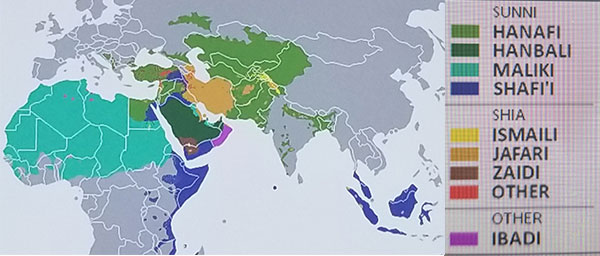
The majority of Muslim people in the world are Sunni.

The vast majority of the Muslims in the world are Sunni, amounting to as much as 85% of the religion’s adherents. They are spread all over the globe – from Morocco to Indonesia – and make up the dominant religion in North Africa and the Middle East. Only Iran, Iraq, Azerbaijan and Bahrain have a Shi’a majority, although there are also significant Shi’a populations in Yemen, Lebanon, Kuwait, Syria, and Qatar.

The divide between the Sunni and Shi’a branches of Islam is both ancient and still highly consequential today.

The Kingdom of Bahrain, which is backed by Saudi has long been ruled by the Sunni House of Khalifa, even though there is a Shi’a majority in the population. Many of the insurgent groups in Iraq today– including the Islamic State terror group – are Sunnis.

The current civil war in Yemen has become a sectarian proxy war, with Iran backing the Shi’a Houthi rebels who overthrew the country’s Sunni-dominated government, while a Saudi-led coalition has since intervened to reinstall the Sunni leadership.

Syria, which has a Sunni-majority population, is ruled by President Bashar al-Assad and his family members of the Shi’a Alawite-sect. The fighting that began as an anti-government rebellion has taken on sectarian overtones. That has spilled over to Iraq, which is Shi’a-majority and has a predominantly Shi’a government but is increasingly troubled by Sunni rebels. And the region’s major powers have long pushed sectarian interests, with Shi’a-majority Iran on one side and Sunni-majority Saudi Arabia on the other.

Filed Under: Politics Tagged With: History, Muslims, President Trump, Shi'a, Sunni, Syria

Israel: The State of the Jewish People

August 31, 2018 By Bella Davidov Leave a Comment

“For Zion’s sake will I not hold my peace,
and for Jerusalem’s sake I will not rest, until her righteousness go forth as brightness, and her salvation (Yeshua) as a torch that burns.” Isaiah 62:1

       God made an everlasting covenant with Abraham – to give him and his descendants the land of Canaan for an EVERLASTING possession and make them into a great nation. Of course Abraham had many descendants, starting with his two sons: Ishmael and Isaac, but God chose the “Son of Promise” through which to pass on His covenant with Abraham.  The promise went through Isaac and then Jacob whose name God changed to Israel – thus Nation of Israel.

God chose the Land of Israel to be His land, and the city of Jerusalem to be be His dwelling place.

I will enter into judgment against them (the nations)…for they scattered My people among the nations and divided up MY LAND… Joel 3:1-2

“For the Lord has chosen Zion; He has desired it for His dwelling place” Psalm 132:13

“Blessed be the Lord out of Zion, Who dwells in Jerusalem!” Psalm 135: 21

Israel and its neighbors.

The League of Nations recognizes Israel is the historic Land of the Jewish people 

In 1920, after winning WWI, the allies met in San Remo, Italy to divide the land that had been occupied by the Turkish Ottoman Empire for 400 years. Until then there were no bordered countries or states. But as Britain and France were given Mandate over the Middle East nation states were created.
On July 24th, 1922, the League of Nations accepted the San Remo Treaty, thus recognizing “the historical connection of the Jewish people with Palestine”* as “the grounds for reconstituting their national home in the country.” Britain was appointed as the Mandatory for Palestine, with the explicit goal of “placing the country under such political, administrative and economic conditions as will secure the establishment of the Jewish national home.”

When the United Nations succeeded the League of Nations, it likewise adopted the San Remo Treaty as binding international law.

In the changing world of the Middle East, and the rest of the world, the Israeli government found it necessary at this time to make it a law that would establish once and for all the fact that Israel is the eternal state of the Jewish people. So now, ninety-six years later, to avoid confusion in the future and to make sure that Israel never gives in to opposition or denial of this right by the Arab world or parts of the West, the Knesset (the Israeli Parliament) passed the “Nation-State Law.

In line with the previously accepted League’s resolution, the “Nation-State Law” acknowledges the land of Israel as “the historical homeland of the Jewish people, in which the State of Israel was established.” Furthermore, it defines this state as “the national home of the Jewish people, in which it fulfills its natural, cultural, religious and historical right to self-determination”.

The law states that Israel is the historical homeland of the Jewish people, that the unified city of Jerusalem is the capital of Israel, that Hebrew is the official language of this state and that Hatikvah (the hope of 2000 years) is its national anthem.

Simply stated, the Nation-State Law legally defines Israel as the national state of the Jewish people in the land of Israel.

Not surprisingly, the law has triggered a wave of protest and opposition from the Israeli left and the Arab-Israeli community. As a democracy, the Knesset has representatives of all parties, including representatives of the Arab citizens. Some of the Arab representatives often express anti-Semitic and anti-Israel sentiments and announcements that in the name of democracy are allowed to be heard. They claim that Palestinian terrorists are “freedom fighters” against Israel’s “occupation”, and in that way justify their terror actions. They also talk openly about turning Israel from a Jewish state into a stated for all its citizens, where Palestinians also have the “right of return.”

Admittedly, the law is a Zionist legislation. Some may claim it is racist or discriminatory, but in actuality does not contradict any value of democracy and equality. This law is not against minority civil rights. It is for Jewish national right. It supports the Jewish people and the minorities living among them.

The law demonstrates its respect for “those who are not Jewish” and recognizes their right to “observe their days of rest on their Sabbath and their holidays.” It also recognizes the “special status of the Arabic language” and even stipulates that while Hebrew is the only official language of Israel, “this clause does not harm the status given to the Arabic language before this law came into effect.” The principle of equality already exists in the civil law.

Civil rights to all citizens of Israel

In response to Israel’s Nation-State law, the Higher Arab Monitoring Committee and the PLO (Palestinian Liberation Organization) named July 19th an official day of protest against “Israeli apartheid”. They protested that the bill is racist, discriminates against minorities. Besides the Arabs, Israelis that represent the far Left and their media join them, because they ideologically oppose the concept of a Zionist state which this law endorses.

On the surface, it may look like a legitimate protest against discrimination, but most Israelis realize that it shows their unwillingness to accept the existence of a Jewish state. The Israeli national anthem, “Hatikvah,” offends them; so various Israeli university departments do not observe it.

Despite all the challenges and threats, Israel is still the safest place to live in this entire region, for Druze, Arab and Circassian – Christians, Muslims, and Jews. Israel’s Arabs enjoy lives of freedom and democracy in the Jewish state. As a matter of fact, there is not even one clause that denies the rights of minorities which were initially incorporated in Israel’s Declaration of Independence. These rights were reaffirmed in the Basic Law of “Human Dignity and Liberty”, passed in 1992, whose stipulated purpose was “to protect human dignity and liberty, in order to establish in a Basic Law the values of the State of Israel as a Jewish and democratic state.”

Civil equality, yes – collective national rights for the Palestinians – no. They can go and seek that among their brothers in Arab countries that have an abundance of land and resources.

The Arab world refuses to accept the existence of a Jewish state, and the idea of Jewish nationality is unacceptable to most Arabs, including the leaders of the Israeli-Arab public, politicians and those in the Arab Higher Monitoring Committee in Israel.

Only Jews have the right to return to the Land of Israel

The only word that does not appear in the State Law, democratically passed in the Knesset majority, is national “equality”.

Only Jews have the privilege to the Law of Return because Israel is the state of the Jewish people, who were taken out of their homeland into exile, were persecuted by the nations and faced annihilation there.  Now they have the right to come back to their home: Israel.

That is what is really bothering the Supreme Arab Monitoring Committee and the Knesset members from the Joint Arab List. They are disappointed that the Arabs will not be able to use Demography as their last resort of eradicating Israel, after trying time and again to use military means.

The Law of Return does not apply to the Palestinians, who now are demanding their own version of it in the form of right of return for Palestinians and family reunification. They are the only refugees who kept refugee status by inheritance.

The Nation-State law is a legitimate method of self-defense for Israel against a demographic flood that might turn Israel into another Arab state. For more on this subject, please go to our blog.

Please stand with us at this time of spiritual warfare as Israel is facing international and domestic criticism over this new state law. Pray for our leadership to have Godly wisdom and strength in devising strategies against attacks. Please stand with us in faith on the promises and Word of God.

For the salvation of Israel and the nations,
In His love,
Simcha and Bella Davidov, Ashdod, Israel

*Palestine was the name given to the land of Judah by the conquering Romans after destroying Jerusalem in 70 AD and taking the majority of the Jews into exile. That name remained throughout subsequent occupations by different conquerors.

Filed Under: Newsletter Archive, Politics Tagged With: History, Our People

Sovereignty Over the Temple Mount

July 27, 2017 By Bella Davidov Leave a Comment

The tension in East Jerusalem has to do with the issue of sovereignty over the Temple Mount. With the escalating violence and tensions in Jerusalem recently, the Temple Mount has become a major item on the social, religious and political agenda. The international community, including Israel, keep repeating the mantra “to maintain the status quo** there.” which states that the Muslim Waqf* manages the Temple Mount, as they have since the Muslim re-conquest of Jerusalem from the Christians in 1187.
This one-sided status quo ignores and denies the divine heritage of the Jews, their return to their land and the establishment of the State of Israel against all odds. To the Jews, it is the most sacred ground on earth. It’s the only Holy Mountain in the world because the Holy God of Israel says it’s His mountain.
In fear of Muslim reaction and threat of an Islamic Arab riot, as well as world criticism, most of Israel’s leaders are reluctant to take a stand for the spiritual right of the Jewish people to “worship the God of Israel on His Holy Mountain, the place He chose for His dwelling place”.

  • Israel is told in Psalm 9:11:  “Sing praises to the LORD, who dwells in Zion! Declare His deeds among the people.” 
  • Isa. 60:14 “and they shall call you The City of the LORD, Zion of the Holy One of Israel.
  • Joel 3:21: “for the LORD dwells in Zion.”
  • Ps. 132:13-14: “For the LORD has chosen Zion; he has desired it for His dwelling place: ‘This is My resting place forever; here I will dwell, for I have desired it.’”
  • Ps. 87:1-3: “His foundation is in the holy mountains. The LORD loves the gates of Zion more than all the dwellings of Jacob. Glorious things are spoken of you, O city of God! Selah.”
  • Also see: Psalm 48; Ps. 87:5; Ps 149:2; Song 3:11; Isa. 33:14; Isa. 33:20; Jer. 9:19; Jer. 30:17; Zech.9:13; Isa. 59:2

History

According to the Hebrew Bible Solomon’s Temple was built atop what is known as the Temple Mount in the 10th century BCE. Solomons’ Temple was destroyed by the Babylonians in 586 BCE, and the Second Temple was built by the Jews, completed and dedicated in 516 BC.
Around 19 BCE Herod the Great began a massive expansion project on the Temple Mount. In addition to fully rebuilding and enlarging the Temple.  The Second Temple was destroyed by the Romans in 70 CE.
According to Wikipedia history encyclopedia, the history of the Temple Mount starts and ends with Israel.
Israelite period – Jerusalem was a Canaanite city called Jebus, established around 1850 BCE in the vicinity of the Temple Mount. The Jewish King David bought the area for fifty pieces of silver from the Jebusite Araunah who owned the area and used it as a threshing-floor (2Sam. 24:24). David wanted to build a sanctuary to the Lord, God of Israel, but the Lord said that David’s  son would be the one to build Him the Temple. King Solomon, David’s son built the first Holy Temple on the site, outside Jerusalem’s wall on the northern edge of the hill.
Persian and Herodian periods – Solomon’s temple was destroyed by Nebuchadnezzar II king of Babylon in 586 BCE and was rebuilt by the Jews under Persian rule around 516 BCE. Herod the Great expanded the Mount and renovated the temple. The Second Temple was destroyed in 70 CE by the Romans.
Roman and Byzantine periods – Roman emperor Hadrian rebuilt Jerusalem and changed the name of the city to Aelia Capitolina and built a temple to Jupiter on the site of the former second Jewish temple on the Temple Mount. All Jews were forbidden to enter the city or the surrounding territory around the city.
In 325 CE, Emperor Constantine I, who promoted Christianity, destroyed the Jupiter shrine on the Temple Mount. Jews were allowed to come to Jerusalem once a year, on Tisha b’Av (9th of the Jewish month of Av)  to mourn the destruction of 2 temples.
In 534 CE Emperor Justinian built a huge substructure as a foundation for the new Church of St. Mary over the site of Solomon’s temple. Other than that, the Temple Mount was neglected by the Romans.
Byzantine period – The Byzantines built elaborate church buildings, monasteries and other public buildings on the Temple Mount.
Muslim period – In 637 CE Muslim Arabs conquered Jerusalem from the Byzantine Empire. Caliph Umar found the Temple Mount covered with rubbish. He built a mosque to the south of the rock over some ruins, known as the Al-Aqsa Mosque. The mosque was completely destroyed and rebuilt several times, the last one in 1035 CE is the one that still stands today.
In 691 CE Caliph Abd al-Malik built around the rock the Dome of the Rock (Qubbat as-Sakhra). The dome was covered in gold in 1920 [with textual and architectural narratives reinforced one another] ??.
For Muslims, the importance of the Dome of the Rock and Al-Aqsa Mosque makes Jerusalem the third-holiest city, after Mecca and Medina. The Dome of the Rock is located close to the area where the Holy Temple of Israel previously stood. The mosque and shrine are currently administered by a Waqf* (an Islamic trust).
The Crusaders – In 1099 the First Crusaders captured Jerusalem and the Temple Mount. The Dome of the Rock was converted into a church called Templum Domini (the Temple of the Lord) and al-Aksa became a church called Templum Solomonis (Solomon’s Temple.)
Back to Muslim rule  – In 1187 Jerusalem was re-conquered by Saladin, and The Dome of the Rock and al-Aksa were changed back into Muslim houses of worship, and have remained so ever since.
The Ottoman Empire – with the expansion of the Turkish Ottoman Muslim Empire, Palestine was included in their conquests in 1516. They prohibited non-Muslims from setting foot on the Temple Mount until the early 19th century, when non-Muslims were again permitted to visit the site.
British Mandate – After WWI, the entire area, including Palestine (today the land of Israel) and Trans-Jordan (today Jordan), was given to the British Mandate, including the Old City of Jerusalem. It maintained the Muslim status quo of the Temple Mount sites. Later, when Jordan became an independent state, it established the current Waqf (religious Muslim Council of the holy places on the Temple Mount.)

After 1948

The State of Israel was established in 1948 after winning the war of independence against its five neighboring Arab nations. East Jerusalem and the West Bank remained in Jordanian hands. Under Jordanian control, Jews were completely expelled from the Old City including the Jewish quarter, and Jews were barred from entering the Old City for 19 years, effectively banning Jewish prayer at the site of the Western Wall.
     Israel period – On June 7, 1967, Israel won the Six Day War against the armies of Egypt, Syria, and Jordan. In the fighting against Jordan, Israel gained control of The West Bank and East Jerusalem, including the Temple Mount.
The Knesset (Israel’s Parliament) passed the Preservation of the Holy Places Law, ensuring the protection of the Holy Places against desecration, as well as freedom of access thereto. The site remains within the area controlled by the State of Israel, with the religious administration of the site remaining in the hands of the Jerusalem Islamic Waqf. Arabs can enter the Temple Mount through one of ten different Muslim-only gates from various sites in the Old City. Tourists and Jews are only allowed access to the site through the Mugrabim Gate (via the Mugrabim Bridge) which is located just above and to the left of the Kotel, (Western Wall) plaza. Non-Muslims are not allowed to pray on the Temple Mount.

Insight

As we see, God has fulfilled His promises and closed the cycle. Now that Israel has come back to the Land, the Temple Mount is in Israel’s hands. For now, God allows it to be religiously administered under Muslim control. If Israel had taken control of the Temple Mount religiously, the Jewish religious leaders would have started building the third Temple, and it is not God’s time, it’s not His purpose yet for Israel. Mean through the Muslim Arabs, the enemy is doing everything he can to cause Israel to completely lose sovereignty over the Temple Mount.

Filed Under: Conflict, From the Newsletter Tagged With: History, Sovereignty, Temple Mount

The 9th of Av and the weeks “Between the Straits”

July 27, 2017 By Bella Davidov Leave a Comment

“From the straits I called to Yah” Psalm 118:5

“The fast of the fourth month” in Zechariah 8:19 refers to an ancient memorial on the 17th of the month of Tamuz in the Hebrew calendar, a time set aside to soberly remember the breaching of the walls of Jerusalem by Nebuchadnezzar. The three-week period between the 17th of Tammuz and the 9th of Av is known as “the Dire Straits” (or Between the Straits, see Lamentations 1:3 “All her persecutors overtake her in dire straits”.)

The period of the Dire Straits starts on the 17th of Tammuz (the month before Av) when Jerusalem’s walls were breached, it’s fall, the destruction of the two Holy Temples on the Temple Mount in Jerusalem on the same day, the 9th of Av, and the Jews going out of their land to Exile – the first time to Babylon for 70 years, and the second to a far greater Diaspora throughout the world for about 2000 years.

The Jews have experienced many calamities over the years, and it is amazing to learn that most of those calamities have occurred on the same day of the year, the 9th of Av.

The Destruction of the Jerusalem Temples, especially the Second Temple, changed the path of Jewish History and of the nation, dispersing the Jewish People among the nations, yet they have survived against all odds. They went through persecution, expulsions and relocation, suffering and calamities. Nonetheless, the wisdom and learning of Jewish tradition was not only preserved, but it also flourished in many countries, enriching the world in many ways.

The 9th of Av, Tisha b’Av, commemorates a list of catastrophes so severe that Jews believe God set them aside for suffering.

Some of the catastrophes and calamities that happened to the Jews on the 9th of Av:

  1. The First Temple was also destroyed on the 9th of Av (423 BCE). Five centuries later (in 69 CE), the Romans drew closer to the Second Temple, ready to torch it. The Second Temple was destroyed the same day as the first.
  2. When the Jews rebelled against Roman rule, they believed that their leader, Simon bar Kochba, would fulfill their messianic longings. But their hopes were cruelly dashed in 133 CE as the Jewish rebels were brutally butchered in the final battle at Betar. The date of the massacre was the 9th of Av!
  3. One year after their conquest of Betar, the Romans plowed over the Temple Mount, our nation’s holiest site.
  4. In 1290 CE on the 9th of Av, the Jews were expelled from England.
  5. In 1492, the Golden Age of Spain for the Jews came to an end when Queen Isabella and her husband Ferdinand ordered that the Jews be banished from the land. The edict of expulsion was signed on March 31, 1492, and the Jews were given exactly four months to leave the country. The Hebrew date on which no Jew was allowed any longer to remain in the land where he had enjoyed freedom and prosperity was the 9th of Av.
  6. World War II and the Holocaust, was actually the outcome of World War I that began in 1914. The day that Germany declared war on Russia, which set the First World War into motion was on the 9th of Av.

Is it by chance, or is it part of a Divine plan that has spiritual meaning? It may not be understood by the human mind, but God has a purpose and a plan that will be fulfilled in His time.

  1. In modern times, the evacuation of Jewish settlers from Gaza in 2005 occurred on the 9th of Av.

According to God’s plan, He intended the 9th of Av to be a day of joy and celebration. When He led the people of Israel out of slavery from Egypt into the Promised Land in the year 1313 BCE, the 9th of Av was the day they were to enter the land of at Kadish Barnea (the short distance from Egypt to the land of Israel.) Spies had been sent into the land and brought back the good fruit of the land to taste. However, 10 of the spies (besides Joshua and Caleb) gave a negative report to the people, lacking faith in God and full of fear. They said to the people that it would be better to go back to Egypt than to be killed by the giants of the land. Because of their unbelief, the day of joy turned into a day of mourning.

God was highly displeased by this public demonstration of distrust in His miracle working power and sent the people back in a long course of 38 years through the desert of Sinai until that whole generation died there, and only their children had the privilege of entering and possessing the Promised Land. (Num. 13-14)

One day, the people of Israel will look upon the pierced Yeshua (Zech. 12:10,) they will proclaim, Baruch haba b’shem Adonai (Blessed is He who comes in the Name of the Lord. Matt. 23:39.) Yeshua said that on that day they will see Him again, but this time they will see Him as He is: their Messiah and Savior. They will mourn for Him as for the firstborn Son. (Zech. 12:10). And then, All Israel will be saved. (Rom. 11:26) On that day God will turn the mourning into great joy again.


Filed Under: From the Newsletter, History Tagged With: History, holidays, the 9th of Av

Names (Part 2): God Changes Names – Man Changes Names

June 7, 2017 By Bella Davidov Leave a Comment

PART TWO

Where does the name Palestine come from?

All of the various Western names such as Palestine, Palestina, and Philistia, come from the original Hebrew word Peleshet, from the root Palash, which is a verb meaning to roll in the dust of the earth and to invade. The Egyptians identified the Pelishtim as “Sea Peoples.” The Pelishtim were not native Canaanites, but invaders from Phoenicia. Pottery found from the cities of Ekron and Ashdod in Philistia are similar in style to pottery found in the Aegean Sea area and on Cyprus. Their main god was Dagon. (Judg. 16:23; 1 Sam. 5:1-7)

The first clear use of the term Palestine that refers to the area between Phoenicia and Egypt occurred in 5th century BCE ancient Greece when Herodotus described a “district of Syria, along the Mediterranean coast called “Palaistine“, which included the Judean Mountains and the Jordan Rift Valley. Other writers referred to the region as Coele-Syria (“all Syria”) around 10-20 CE.

The Jewish historian Josephus (37-100 AD) quotes Herodotus in referring to “Syria of Palaistine” and “the Syrians that are in Palaistine“, inhabitants of Palaistine who are circumcised are Jews.” This confirms that Jews lived in Palaistine at that time.

In the Bible, the names “Palestia” or “Philistia” occur fewer than ten times in the Old Testament. For example: “What have ye to do with me, O Tyre, and Sidon, and all the coasts of Palestia?” (Joel 3:4- 4:4; Exod. 15:14; Isa. 14:29, 31; Ps. 60:8; 83:7; 87:4; 108:9). The term is never used to refer to the whole land of Israel, but to the southwestern coastal area. The rest of the land was called Canaan.

The inhabitants of Peleshet were called the Pelishtim, Philistines in English. This word occurs 287 times in the Hebrew Bible (Some examples: Gen. 10:14; 26:1; Exod. 13:17, etc., many in Judg., 1 & 2 Sam., and 1 Chron., Jer. 6:26; Ezek. 27:30; Mic. 1:10).

The Pelishtim

From the time the Israelites first entered Canaan, under Joshua’s leadership, the “Philistines” were and remained the enemies of Israel. Their centers of power were the five cities/states along the coast of southern Canaan: Ashkelon, Ashdod, Ekron, Gath, and Gaza. However, their battlegrounds of fighting Israel spread to other parts of the country, the most famous one, David against the giant Philistine Goliath (from the city of Gath). Those cities were promised by God to the tribe of Judah in Joshua 15:1, 46, 47: “This then was the lot of the tribe of Judah…from Ekron to the sea, all that lay near Ashdod, with their Villages; Ashdod with its towns and villages, Gaza with its towns and villages-as far as the Brook of Egypt and the Great Sea (Mediterranean) with its coastline.”

The ancient Philistines are long gone and there are no descendants. God said in His word that He would destroy the Philistines in several prophecies including: “Thus said Lord YHVH: I will stretch out my hand against the Philistines and cut off the Cherethites and wipe out the last survivors of the seacoast” (Ezek 25:15-16).

Jeremiah forewarns that “the day is coming” when “YHVH will ravage the Pelishtim, the remnant from the island of Caphtor” (Jer 47:4). Archeologists believe Caphtor is likely the island of Crete.

Neither “Palestina” or “Philistia” occur in the Greek New Testament. When Titus destroyed Jerusalem in 70 A.D., the Roman government issued a coin with the phrase “Judea Capta,” meaning Judea has been captured. The term Palestine was never used in the early Roman days.

It was not until the Romans crushed the second Jewish revolt against Rome in 135 CE under the leadership of Bar Kochba that Emperor Hadrian changed the name of the Land of Israel to Palestine.  He replaced the Jewish shrines in Jerusalem with temples to pagan deities and changed the name of Jerusalem to Aelia Capitalina. Hadrian’s choice of the name Palestine was not accidental. He used the name of the ancient enemies of Israel, the Philistines and gave it a western name to replace the name Land of Israel. His purpose was to erase the name Israel from all memory and erase the Jewish connection to the land.

Following the Muslim conquest in the 7th century, names of places that were in use by the Byzantine administration generally continued to be used in Arabic, including the use of the name “Palestine.” The land was still Palestine when it became part of the Turkish Ottoman Empire in the years 1517-1917.

In the 20th century, after the British won the 1st World War and conquered the land from the Turks, the name was used by the British to refer to “Mandatory Palestine”, though they called the land on both sides of the Jordan River, Palestine. This became the accepted geo-political term for several decades, and those who lived in the land were called Palestinians, whether they were Jews, Arabs or Europeans.
Today’s Palestinians
After Israel became a nation in 1948, the name of the land was changed back to Israel and the Jews were called Israelis. Only in 1968, The Palestinian National Charter, as amended by the PLO’s Palestinian National Council  defined “Palestinians” as “those Arab nationals who, until 1947, normally resided in Palestine regardless of whether they were evicted from it or stayed there. Anyone born, after that date, of a Palestinian father—whether in Palestine or outside it—is also a Palestinian.”

Unfortunately, today even many Christians continue to refer to the Land of Israel as Palestine. by this, they join the world, pagans, and haters of Israel in calling Israel by the anti-Israel term of Palestine.

The enemy of God hates the reality of the restoration of Israel as the nation that will ultimately receive Jesus as the Messiah at His return and be saved. God chose Israel as His people and Jerusalem as His dwelling place. There is no mention in His word of Palestine or Palestinian people occupying the land. He gave the people of Israel the Land for an everlasting possession. The only term we, as believers in Yeshua, should use for the Land of Israel is Israel, and the so-called occupied territories Judea and Samaria.

So Where does the name Palestine come from? As opposed to the name Israel, which God chose, Palestine is a name that men chose to usurp God’s authority and purpose for His Promised Land and People.

Please pray for God’s truth to prevail in the Land of Israel and the world.
[Read more about the history of Israel in our Blog: History from the Ottoman Empire to the Establishment of the State of Israel and The Land of Israel Was Legally Purchased]

Filed Under: History, Newsletter Archive Tagged With: Anti-Semitism, History, Palestine, Temple Mount, terror

  • « Go to Previous Page
  • Page 1
  • Page 2
  • Page 3
  • Page 4
  • Go to Next Page »

Primary Sidebar

  • Return to Home Page
  • Email

War

They Shall Come Back

And they shall come back from the land of the enemy. There is hope in your future, says the Lord, your sons shall come back to their own border.  Jeremiah 21:16b-17 This happened today, Monday October 13. Exactly two years ago, on the Holiday of Succot (booths), Hamas brutally attacked southern Israel from Gaza, murdering 1,200 Israelis and abducting 251 into […]

U.S. President Trump’s Epic Fury -Where Is It Going?

March 26, 2026

"אַרְיֵה שָׁאָג מִי לֹא יִירָא " "The lion has roared, who will not fear?..." Amos 3:8a The world is trying to understand President … [Read More...] about U.S. President Trump’s Epic Fury -Where Is It Going?

Recent Posts

  • Best Allies
  • U.S. President Trump’s Epic Fury -Where Is It Going?
  • Israel at War with Iran – Operation Roaring Lion
  • The Jewishness of Christmas
  • Hamas in America

Categories

© MMXXVI Yeshuatami, Ashdod ISRAEL