• Skip to primary navigation
  • Skip to main content
  • Skip to primary sidebar
  • Return to Home Page

Yeshuatami News Blog

All Things Israel

  • Conflict
    • Terrorism
  • History
    • Aliyah
    • End-time Prophecy
  • Politics
    • US
  • Israel
    • Holidays
    • Our People
  • From the Newsletter
    • Newsletter Archive
  • Give

Terrorism

Israel Threatened

August 6, 2024 By Bella Davidov Leave a Comment

“So shall all Your enemies perish, O Lord; but they that love Him
be as the sun that shines in full strength…”

Judges 5:31

Last week Iran’s supreme leader, Ayatollah Ali Khamenei, officially endorsed and empowered 69-year-old heart surgeon, Masoud Pezeshkian, as the new Iranian President. Pezeshkian replaces President Ebrahim Raisi who died in a helicopter crash in May.


Iran’s New President: Pezeshkian

Pezeshkian was sworn in as Iran’s ninth President at a ceremony attended by senior officials from several countries including Armenia, Tajikistan, Egypt, Sudan, Iraq, Turkey, Saudi Arabia, Azerbaijan, Cuba, and Brazil, and even the European Union envoy Enrique. Also present were Iran’s proxy leaders including the late Hamas leader, Ismail Haniyeh; Islamic Jihad head, Ziyad al-Nakhalah; Hezbollah Deputy Secretary General, Naim Qassem, and Yemen’s Houthi spokesman, Mohammed Abdulsalam.

During the ceremony, many chanted, “Death to Israel, Death to America.”

A day earlier, Pezeshkian warned Israel against attacking Lebanon, saying “heavy consequences” would ensue. Pezeshkian also reaffirmed support for the so-called “axis of resistance,” the Hezbollah and Houthis terrorists that support Hamas against the Zionist enemy – Israel.

The ceremony took place amid concerns of an all-out war between Israel and Hezbollah following Hezbollah’s rocket attack which killed 12 children in a soccer field in the Druze town of Majdal Shams on the Israeli Golan Heights. In response, Israel struck Beirut, the capital of Lebanon, targeting and killing Fouad Shukur, a top Hezbollah commander allegedly behind the rocket attack. According to Israel, Shukur was responsible for most of Hezbollah’s superior weaponry as well as Hezbollah’s attacks on Israel since October 8, a day after the Israel-Hamas war erupted. [Image of Fouad Shukur from Post Register Lebanon]

Ismail Haniyeh
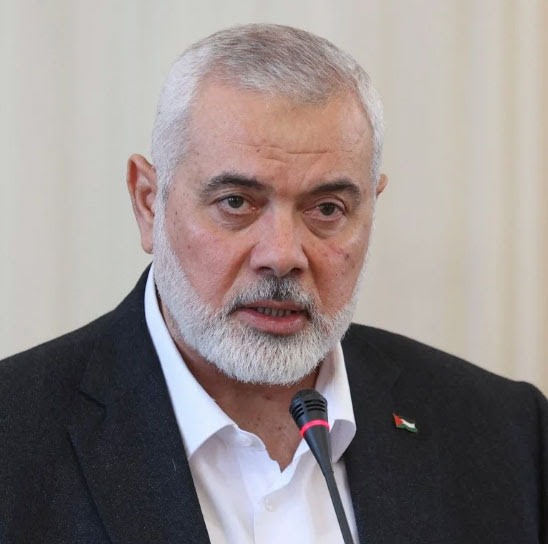
Hours later, in Iran’s capital, Tehran, a direct missile hit Haniyeh’s residence, killing him and one of his bodyguards. [Image from South China Morning Post]

Iran and the militant Revolutionary Guard group immediately blamed Israel for the surprise assassination that risks escalation into an all-out regional war. Iran’s supreme leader vows revenge against Israel. Israel had pledged to kill Ismail Haniyeh and other Hamas leaders over the group’s October 7th attack on southern Israel that erupted into war in Gaza.

Meanwhile, Israel has not taken responsibility for Haniyeh’s assassination. Without mentioning Haniyeh’s death, Israeli PM, Netanyahu, proclaims that Israel “will exact a very heavy price from any aggression against us on any front.There are challenging days ahead.”

Israel often refrains from commenting on assassinations carried out by its Mossad intelligence agency or strikes on other countries.

Israeli Defense Minister Yoav Gallant has stated that Israel doesn’t want war despite killing the Hezbollah commander in Beirut, “but we are preparing for all possibilities.” He did not mention Haniyeh’s death.

Haniyeh left the Gaza Strip in 2019 and lived in exile in Qatar. Israel has targeted Hamas figures in Lebanon and Syria but targeting Haniyeh in Iran’s capital was vastly more involved, though Israel has operated there under cover in the past.

Following Haniyeh’s assassination, Iranian supreme leader, Ayatollah Ali Khamenei, declared that revenge was “our duty” and that Israel had “prepared a harsh punishment for itself” by killing “a dear guest in our home.” Iran’s Revolutionary Guard warned that Israel would face a “harsh and painful response” from Iran and its allies around the region. The Iranian Parliament held an emergency meeting later that day.

Hamas said Haniyeh’s assassination “takes the battle to a new level and will have major repercussions on the entire region.”

Khalil al-Hayya, a powerful Hamas figure formerly close to Haniyeh, said that Haniyeh’s replacement would “follow the same vision” regarding negotiations to end the war and continue the same policy of resistance against Israel.

Haniyeh’s killing creates the potential for direct confrontation between Iran and Israel should Iran choose to retaliate.

Israel and Iran – Bitter Enemies

Bitter enemies for years, Israel and Iran risked war earlier this year after Israel hit Iran’s embassy in Damascus in April. Iran retaliated by sending about 300 missiles and drones into Israel, most of which were intercepted by Israeli and Israeli allies’ defense mechanisms. Israel countered with an unprecedented strike on Iran’s facilities. However, international efforts succeeded in containing the violence before an all-out war broke out.

Besides direct retaliation on Israel, Iran could increase attacks through its proxies, the so-called “Axis of Resistance,” including Hezbollah, Hamas – mainly Shiite militias in Iraq and Syria – and Yemen Houthi rebels.

Netanyahu’s Response

Netanyahu declares that Israel will continue its war in Gaza until Hamas is totally eliminated. He asserts that Israel’s achievements in recent months are due to resisting pressure to end the war at home and abroad.

Hamas’ demand to end the war; to release a small number of abductees and to continue supplying weapons into Gaza while remaining in power is unacceptable to Netanyahu. Israel will never agree to demands that endanger its security; it would be a complete surrender to the terrorist group. Israel will continue fighting until complete victory is achieved, declares Netanyahu.

Please Pray

  • May all the plans of the enemy be null and void, in Yeshua’s name.
  • May the enemy’s traps be traps unto themelves.
  • May the enemy fall into each and every trap it prepares for Israel.
  • May confusion reign among Israel’s enemies. 
  • Please Lord, send Your warring angels to thwart each and every rocket thrown  at Israel.
  • May the God of Israel glorify His Name in bringing victory to Israel, His inheritance.  
  • Please continue to stand together with us for the protection of Israel from her surrounding enemies.
  • Father God, we worship You and thank you for giving the Israeli government and the army commanders wisdom and unity in making crucial decisions  during these challenging times.
  • Lift up in prayer the hostages in Gaza, the many thousands OF evacuees from their homes and the soldiers in line of duty and those in the reserves.
  • Father God, we thank You for drawing many Israelis to You during these war times(almost 10 months now)
  • We especially pray for the families who have lost loved ones, fathers, children, relatives and friends during the war.

Other image: Enormous Funeral for the 12 child victims of the bombing of a children’s soccer field in Madjal Shams. Photo from The Guardian

Filed Under: Conflict, From the Newsletter, SideBarStoryWidget-top Tagged With: Gaza, Hamas, Israel Threatened, Lebanon, Terrorism, War

Wars and Rumors of Wars

June 27, 2024 By Bella Davidov Leave a Comment

The Lord said to me [Jeremiah], “From the north calamity shall break forth on all the inhabitants of the land.” 

Jeremiah 1:14 NKJ

The Dangerous Scope of the War

Israeli Prime Minister Benjamin Netanyahu has said recently that Israel is fighting battles in seven sectors across the Middle East – against Hamas in Gaza, against Hezbollah in Lebanon, against the Houthis in Yemen, against the Iranian-backed militias in Iraq and Syria, against Iran itself and against Palestinian terrorists in Judea and Samaria.

Furthermore, the Jewish state faces a diplomatic battle against the International Criminal Court, whose chief prosecutor is seeking arrest warrants for Netanyahu, Defense Minister Yoav Gallant, and even the IDF itself.

Nevertheless, Netanyahu insists that he will resist international pressure in pursuit of the goals of the war: eliminating Hamas, bringing the hostages home, and ensuring Palestinian terrorists never again pose a threat from Gaza.

“We are committed to total victory,” Netanyahu said. He emphasized that he was not prepared to accept Hamas’ demand that Israel halt the war without achieving war goals.

“Our future will not exist here against the axis of evil of Iran and its proxies if we simply fold our hands,” he said. He reiterated that among those war goals was the safe return of all the hostages.

Since Oct. 8, Hezbollah – Iran’s greatest proxy on the northern Israeli border – has been firing rockets and drones from southern Lebanon into northern Israel. The attacks have escalated over recent days, forcing more than 100,000 Israelis in northern Israel to evacuate their cities, farms, and villages. 

Photo from Buzzkue – Hezbollah Rocket and Drone Attacks Spark Fires in Northern Israel.

Tragically, in the Galilee area, Hezbollah rockets have caused many fires, consuming thousands of acres of forests.

Israel is rightly concerned that a full-blown war with Hezbollah would cause many deaths and much destruction in Israel. Unfortunately for Lebanon, already a failing state controlled by Hezbollah, it also faces great destruction from which it might never recover.

There is pressure on Israel from the Biden administration that is increasing its efforts to de-escalate the growing tensions between Israel and Hezbollah in order to prevent a full-scale war. 

Hezbollah is using the war against Hamas as an excuse for its attacks in order to achieve its goal of taking from Israel the Har Dov strategic area, a region lying one hundred feet south of the Lebanese border. However, Har Dov is already recognized by the UN as Israeli territory. 

Nevertheless, Lebanon (Hezbollah) claims the area as its own. The US administration has been involved in talks with Lebanese officials to resolve the conflict. Unfortunately, the Lebanese government is powerless against Hezbollah. 

Israeli Prime Minister Benyamin Netanyahu has repeatedly said that he is committed to returning the evacuated Israeli citizens to their homes by finishing the fighting either by diplomatic or military efforts. 

“Hamas, and the other Iranian proxies, understand very well that we will fight with all means against their terrorism . … “Whoever tries to hurt us, whoever finances and organizes, whoever dispatches terrorists against Israel – will pay the full price,” Netanyahu said.

In response, Hezbollah leader Hassan Nasrallah said that any Israeli military action in Lebanon including the assassination of Lebanese, Palestinian, or Iranian officials would drive his organization to retaliate.

In his recent visit with UN Secretary-General Antonio Guterres in New York, Israeli Defense Minister Yoav Galant stressed the urgent need for immediate UN intervention in de-escalating tensions by strengthening UN peacekeepers’ authority in the region, ensuring their freedom of movement, and implementing their mandate. “Israel will not tolerate increasing threats to the security of its citizens, and will act as required in their defense,” Gallant added.

While Israel seeks first a diplomatic solution, it is obvious that the Proxies of Iran (including Hezbollah) will violate any and every ceasefire or peace agreement as they have always done in the past.
 

Our Past Treaty with Lebanon

Following the 2006 war between Hezbollah and Israel, the ceasefire agreement and Security Council Resolution 1701 demanded from Israel a complete cessation of hostilities against Hezbollah in exchange for Hezbollah’s disarmament and the establishment of a zone from Lebanon’s border with Israel to the Litani River “free of any armed personnel, assets, and weapons other than those of the Government of Lebanon” and a U.N. force presence. 

While Israel honored the agreement, Hezbollah did not. The 10,000 U.N. troops deployed to enforce the demilitarization of southern Lebanon were powerless against Hezbollah’s blatant violation of the ceasefire agreement as Hezbollah hid thousands of missiles in mosques, hospitals, schools, and homes. Gradually, with the help of Iran, Hezbollah has increased in power in Lebanon, politically and militarily.

The question now is, how long can Israel allow Iran’s proxy on its northern border to continue its daily attacks, turning the Galilee region into an uninhabitable fire zone?

For now, the Israeli army continues to battle Hamas in Gaza in the south, while preparing for all-out war against Hezbollah in the north. 

Eventually, Israel must end the attacks from both terrorist jihadist groups.
 

With God’s Help

As Netanyahu has said in many of his speeches: “With God’s help we will win.”

Many in Israel, Arabs and Jews, and around the world join the effort to cover our country with prayers following the escalation security situation in the face of the treat of full-out war with Hezbollah are praying for this situation, including us in the Prayer and Worship tent on our roof here in Ashdod. Please join us in this effort. 

Pray for the protection of the citizens in the Galilee and our soldiers who are fighting on all fronts.

This is not just a physical war but mainly a spiritual war, as our chief enemy, is determined to annihilate the Jewish people. We trust the God of Israel and the world, Adonai Tzevaot will not abandon His people.

…For You [Lord] have struck all my enemies on the cheekbone; You have broken the teeth of the ungodly. Salvation belongs to the Lord. Your blessing is upon Your people. Selah

Psalm 3:7-8 NKJ

Other image: Photo from the Wall Street Journal. The Iron Dome in action.

Filed Under: Conflict, From the Newsletter, SideBarStoryWidget-top Tagged With: Gaza, Hamas, Terrorism, War

The U.S. Administration – Friend or Foe of Israel?

May 12, 2024 By Bella Davidov Leave a Comment

“It will come about on that day
that I will make Jerusalem a heavy stone for all the peoples;
all who lift it will injure themselves severely.
And all the nations of the earth will be gathered against it.”

Zechariah 12:3 NAS

Pledging Total Victory over Hamas

Israeli Prime Minister Benjamin Netanyahu is still pledging “total victory” against the Palestinian jihadists of Hamas.

“We will finish the task with our brave soldiers,” he said, “and ensure the civilian population has corridors to safety.”

For the last few months, Israel has been preparing to extend its activities to Rafah, Gaza’s south most city, with the intent to continue its full-scale operation in the Gaza Strip, ‘paving the way for a shift to a lower-intensity phase of targeted airstrikes and special forces operations.’ According to an Israeli military chief, this will happen after significantly damaging Hamas’ last remaining stronghold.

In order to achieve victory, Israel must dismantle Hamas’ control in Rafah. However, world leaders are more concerned about the humanitarian conditions in Rafah even though Israel encourages Gazans to evacuate their homes in order to avoid civilian casualties. While planning Operation Rafah, targeting Hamas fighters, command centers, and tunnels, the IDF is also taking extraordinary measures to avoid civilian casualties.

“There were 24 regional battalions in Gaza – we have dismantled 18 of them. Rafah is the last Hamas stronghold,” a top military Israeli stated. A Hamas official based in Qatar told the press that some 6,000 terrorists have been killed in the Gaza Strip since October 7; about half of the 12,000 IDF claims to have been killed. The Hamas source claimed the terrorist group is prepared for a long war in Rafah.

“Prime Minister Benjamin Netanyahu’s options are difficult and ours are too. He can occupy Gaza but Hamas is still standing and fighting. He hasn’t achieved his goals to kill the Hamas leadership or annihilate Hamas.”
 

Who Decides for Israel?

In every Israeli war a coalition of world leaders along with some Israeli traitors, have tried to sabotage a full Israeli victory in military operation, or all-out war. They unite for the sole purpose of Israel’s defeat, especially when Israel is very close to complete victory. And this is exactly what is happening right now with world leaders, even Israel’s supposed ally, U.S. President Biden.   

Picture from Times of Israel.

While at the beginning of the war, Biden was supporting Israel in eliminating Hamas in Gaza, he is now doing everything in his power to ensure the survival of Hamas. By providing Gaza with fuel and humanitarian aid that Hamas steals at gunpoint, as well as unending pressure on Israel for a long cease-fire, Biden ensures Hamas’ survival over total Israeli victory and the release of Israeli hostages.                                                                                                     

Naturally, this aligns with Hamas’ aspirations for a long cease-fire that will prevent a full Israeli operation and Hamas’ defeat in Rafah.

Hamas hopes for a long cease-fire that will prevent a full-scale Israel operation and Hamas’ defeat in Rafah, Israel last crucial phase of the battle, which will ensure Israel’s complete victory.

Israel’s future as a sovereign, Jewish nation in the land of Israel is at stake. Not entering Rafah was a risk Israel could not afford to take. Not entering Rafah would have been a military disaster preventing Hamas’ complete destruction as a military and political ruler in Gaza.

Victory is so close, as PM Netanyahu said. It is a matter of weeks, not months.

President Biden worries that an Israeli ground operation crossing into Rafah through the Egyptian border will harm his relationship with Egypt as he says, “I’ve worked very hard to make sure we have a relationship and help. I’ve made it clear to Bibi and the war cabinet that they’re not going to get our support if, in fact, they go into these population centers.”

Rafah is the southernmost city in the Gaza Strip with an estimated million displaced people. It is also the entry point for much of the humanitarian aid into the Strip. Moreover, most of the Hamas leaders and remaining military forces are there, Israel says, along with the remaining hostages, both alive and dead.

Pictured left: Rafah Crossing from Wikipedia

Biden said a potential invasion of Rafah was ‘a red line’ for him.

In an interview, U.S. President Biden said he believes Netanyahu is “hurting Israel more than helping Israel” in his approach to the war, adding “He must pay more attention to the innocent lives being lost as a consequence of the actions taken.”

Finally, the IDF has begun conducting what it describes as ‘targeted strikes’ against Hamas operatives in eastern Rafah. IDF spokesman Rear Adm. Daniel Hagari said Israeli aircraft struck more than 50 terrorist targets in Rafah amid the evacuation of residents in the area and the expansion of the humanitarian area in other parts of Gaza.

However, it was with limited force, which would not overtake all the Hamas forces there. In this first stage, Israeli soldiers attacked the east side of Rafah, which is mainly sand with little population and not many tunnels. It is obvious that this stage will not conquer Hamas but may bring them into agreement with Israeli terms to release the hostages.

Pictured Right: Map of Rafah Crossing from Twitter, Jordan News Daily

PM Netanyahu faces another problem in bringing into the war cabinet his rival, former defense minister, Benny Gantz. At the start of the war, this was essential in order to form an emergency, united coalition to unite the nation in the war effort. However, Gantz sides more with Biden than with Netanyahu.

It seems that Biden is more interested in removing Netanyahu as PM than in destroying Hamas. Netanyahu made it clear that his government will not allow for a Palestinian state under the current Palestinian authority in the West Bank and/or Gaza, which is part of Biden’s administration’s ‘regional

Integration’ policy. This policy allows Iran to continue operating through its proxies in the Middle East, with the goal of destroying Israel.

Biden sees Netanyahu as an obstacle to his plan to ‘share the neighborhood’ with Israel’s enemies. Hence, Biden and his administration want Netanyahu’s opponents to do the work for them – to defeat Netanyahu by interfering in Israel’s politics and war effort.And There is Benny

Biden has found a partner in Benny Gantz, hoping Gantz will replace Netanyahu as Israel’s next PM and form a left-wing coalition more favorable to his Two-state Solution, giving Judea and Samaria and the Gaza Strip to the Palestinians.

Never before has a U.S. administration so undermined Israeli democracy and sovereignty, dictating to an Israeli PM and army how to fight its enemies who seek to destroy the one and only Jewish state.
 

Why is Israel So Concerned?

Trusting in the U.S. presidential declarations – Obama’s and Biden’s included – to always support Israel, Israel stopped heavy precision ammunition productions decades ago and relied on its ally, the U.S. for unconditional supply of the ammunition. But this has backfired.

Now, dependent on American ammunition, Israel has given in to Biden’s demands to supply the Gazan enemy with massive humanitarian aid – the U.S. is even building a seaport to subvert Israel’s control of the flow of goods into Gaza – and respond with minimum force to Iran’s massive missile attack thereby, according to Biden’s request, preventing an escalation in the region.

President Biden and many Democrats publicly used foul language against Netanyahu. The Jewish Senate Majority Leader, Chuck Schumer, called on Israel to hold new elections, saying he believed Prime Minister Benjamin Netanyahu had ‘lost his way’ and was an obstacle to peace in the region.
 

What Can the President Gain or Lose in this War?

By using Israeli and American Jewish leftists who oppose Netanyahu, Biden desires to disassociate himself from an anti-Israel or anti-Semitic image which could damage his re-election in key states like Florida, Arizona, and Michigan in light of anti-Jewish and pro-Hamas mobs across U.S. campuses.

Sadly, there exist anti-Zionist government Israeli officials who seem to be U.S. administration collaborators, likewise using mob demonstrations against Netanyahu. The Israeli organizers of these anti-Bibi demonstrations admit that they are in constant communication with the White House.
 

Where Do We Stand Now?

Last week, U.S. President Biden ordered PM Netanyahu not to enter the City of Rafah. During their 30-minute phone conversation between them, that Biden warned that should Israel go forward with the ground operation in Rafah, he would withhold military aid to Israel. Netanyahu made it clear that to defeat Hamas there was no choice but to conduct the ground operation in Rafah, wherein remain Hamas’ last four terrorist battalions.

Biden stated he is willing to supply Israel with defensive weapons such as the Iron Dome, but not weapons and artillery shells capable of destroying the vicious Hamas enemy.

“We will fight with our fingernails if we have to” responded PM Netanyahu.

Picture by M&AB// Mahsanai Hashuk

Please pray!

  • Israeli forces have gone into east Rafah. Along with killing about 50 Hamas terrorists, there were also Israeli casualties at the time of this writing. Please pray for the safety of the Israeli fighters.
  • Some brave Israeli citizens are blocking the entrance of “humanitarian aide” trucks “until our hostages are returned”. Please pray for the success of Israel in finding and rescuing the hostages.
  • Rockets continue to come into the north and the south, aimed at Israeli civilians. Please pray for protection of our forces and for them to be able to stop the attacks.
  • There are terror events in Judah and Samaria. Please pray for Israeli forces success of the counter-terrorist fighting.
  • Please pray for an increase of Israeli forces in Rafah and complete victory over the remaining Hamas forces.

Filed Under: Conflict, From the Newsletter, SideBarStoryWidget-second Tagged With: politics, Terrorism, War

The Threat of Ramadan

March 14, 2024 By Bella Davidov Leave a Comment

With war in Gaza raging, tensions in East Jerusalem and in Judea and Samaria, (aka the West Bank territories) are escalating with the start of the holy month of Ramadan, particularly on the Temple Mount. Located in east Jerusalem’s Old City, the Al-Aqsa Mosque compound on the Temple Mount is considered the third holiest site in Islam, while to the Jews it is the most holy site as the location of the two ancient Holy Temples.

Even after Israel won the Six Day War and conquered and annexed east Jerusalem in 1967, including the Temple Mount, the Muslim religious facilities of the Temple remained under the administration of the Waqf, dedicated to Muslim religious purposes. All Islamic religious activity has remained under Jordanian control since the cease-fire of the 1948 war of Israel’s independence.

In Islam, the holiday of the Ramadan fast (and feasting every night) observed by millions of Muslims around the world is supposed to be a time of prayer, reflection, and community. The Muslims believe that during this holy month, their holy book, the Quran, was revealed to the Prophet Muhammad.

However, since Israel gained control of the grounds of the Temple Mount, each year, the time of Ramadan has become particularly inflammatory. Every year violence erupts on Ramadan as Palestinians use the compound and even the mosque itself to riot and throw rocks in provocation of Israeli forces who are there to keep law and order. When Palestinian rioters are injured and many are arrested as a result of Israeli police dispersing rioters, even more violence ensues.

Image above: Cartoon by Alaa’ al-Laqta. Right: Incitement to violence.  The Arabic reads, “The meal of young Jerusalemites before the Ramadan fast” (Alaa’ al-Laqta’s Facebook page, April 23, 2021).

In 2022 and 2023 during Ramadan, inspired by Hamas and carrying Hamas flags, Palestinian terrorists shot, stabbed, and threw bombs on Israelis praying at the Western Wall below. PA (Palestinian Authority in Judea and Samaria) President Mahmoud Abbas negated any Jewish connection to Jerusalem by declaring, “We alone have the religious, historical, and legal right to Al-Buraq Wall (the Western Wall).”

Ramadan is not like any holiday in other religions. Rather than being a month of peace and harmony, it is a month of war and violence. From Islam’s beginnings, Ramadan was a time to wage war.

History of Ramadan

In 624 CE, during Ramadan, the Prophet Muhammad waged his first jihad (holy war). In 632, during the month of Ramadan, Muhammad attacked and conquered the city of Mecca with its Kaaba stone, which is Islam’s most holy site today.

Throughout the centuries, Muslims have waged wars and conquests during Ramadan. A few more examples are:

  • The conquest of Rhodes in 653 CE
  • The invasion of Spain in 710 CE and 
  • Battles against the Crusaders over Jerusalem led by Salah Al-Din in 1187 CE.
  • In 1260, Muslims defeated the Mongols in Palestine (now Israel,)
  • In the 20th century, between 1962 to 1970, during the Yemeni Civil War, Muslims fought each other through nine Ramadans.
  • In 1973 on the Jewish holy day of Yom Kippur, Egypt and Syria, on Ramadan launched a surprise attack on Israel. The Israelis call it the Yom Kippur War whereas they call it the Ramadan War.  
  • In 1981, Iran rejected an offer for a Ramadan cease-fire from Iraq, and a year later attacked Iraq in what they called, “Operation Ramadan.”
  • Likewise, in 1987, Iran again rejected an offer of a Ramadan cease-fire from Iraq.
  • In Israel, Palestinians rioted from the years 1987 to 1993 during six Ramadans. From the 1990s and well into the beginning of the 21st century, during Ramadan, Muslims continued to war in other locations than just in Israel. For example, widespread fighting occurred in Kashmir when Muslims rejected a Ramadan cease-fire offered by India as a step for peace.

Ramadan Today

Now, at the start of Ramadan, as the war in Gaza continues, Hamas is calling for violence against Jews.

In a speech prior to the start of Ramadan which began on March 10th, Hamas political leader, Ismail Haniyeh, incited Palestinians in Jerusalem, Judea, and Samaria to storm the Al-Aqsa mosque on the Temple Mount.

Haniyeh also called for the Iran-aligned “Axis of Resistance” members including Hezbollah, the Houthis, and various Iraqi Shia militias to escalate their attacks against Israel. A spokesman for Palestinian Islamic Jihad (PIJ), another Iranian-backed Palestinian terror group, called for a “month of terror” against Israel during Ramadan.

It is obvious that Hamas, under the guise of this holiday, intends to inflame religious tensions and increase attacks against Israelis, so the month of Ramadan begins the second phase of their plan that began on October 7th. Unfortunately, also the PA has increased incitement against Israel during this fragile period.

Unlike Hamas, Israel intends to do everything possible to decrease tension and prevent violence during this volatile time. Israel’s policy is to maintain religious freedom and access to holy places for all religions, including access for Palestinians and Israeli Arabs to Muslim holy sites on the Temple Mount.

Filed Under: AntiSemitism, History, Terrorism Tagged With: Anti-Semitism, Hamas, Ramadan, Temple Mount, Terrorism, War

The Miracle of Purim

February 24, 2024 By Bella Davidov Leave a Comment

In the book of Esther, the administrator to the King of Persia was Haman the Agagite who held the second highest position in the land. Like the antichrist, Haman was moved by Satan to totally eradicate the Jews who lived in the Kingdom of the Medes and Persians during the reign of King Ahasuerus (aka Xerxes I) 486-465,64 B.C.

Haman hated Mordecai the Jew. Since Mordecai refused to bow down to Haman or pay him homage like everyone else in the king’s court, Haman was filled with wrath against Mordecai. When Haman learned that Mordecai was a Jew, Haman sought to destroy all of Mordecai’s people living throughout the whole kingdom of Ahasuerus.

Readings from Esther 3:5-14

“In the month of Nisan, in the twelfth year of King Ahasuerus, they cast Pur (that is, the lot, hence the word Purim), before Haman to determine the day and the month of the Jewish massacre until it fell on the twelfth month, which is the month of Adar.”

Haman said to King Ahasuerus, “There is a certain people scattered and dispersed among the people in all the provinces of your kingdom; their laws are different from all other people’s, and they do not keep the king’s laws. Therefore, it is not fitting for the king to let them remain. If it please the king, let a decree be written that they be destroyed, and I will pay ten thousand talents of silver into the hands of those who do the work, to bring it into the king’s treasuries.” (Esther 3:8)

The king refused to take the bribe but granted Haman his request. He gave Haman, the enemy of the Jews his signet and told Haman to do to the Jews as he pleased. So, in the name of Ahasuerus and sealed with the king’s signet ring, the decree was written to destroy, to kill, and to annihilate all the Jews, both young and old, little children and women, in one day, on the thirteenth day of the twelfth month – the month of Adar, and to plunder their possessions.

Mordecai, a God-fearing Jew, had raised orphan Hadassah (later named Esther) to be a God-fearing young lady. Hadassah was the most beautiful of all the women selected for the harem and was chosen by the King of Persia to be his queen in place of Queen Vashti. (Esther 2:17)

Mordecai, however, instructed Esther not to reveal her heritage. 

While Esther was at the king’s harem, Mordecai learned about Haman’s plan, and the king’s edict to destroy the Jewish people. Mordecai then ordered Queen Esther to appear before the king and plead for the survival of her people.

Mordecai challenged Esther by saying: “Do not think in your heart that you will escape in the king’s palace any more than all the other Jews. For if you remain completely silent at this time, relief and deliverance will arise for the Jews from another place, but you and your father’s house will perish. Yet who knows whether you have come to the kingdom for such a time as this?” Esther 4:13-16

Queen Esther knew that only another royal decree issued by the king could save her people. No Persian royal decree could be rescinded. She had to arrange an audience with the King.

Esther instructed all the Jews in the capital city of Susa to fast for three days, neither eating nor drinking for a full three days and nights during which time she and her maids would likewise fast.

And Queen Esther declared: “so I will go to the king, which is against the law; and if I perish, I perish!” Esther 4:15-17 (Today, in commemoration of that fast, many Jews fast the day before Purim, praying for God’s continual preservation of Israel.)

In Persia, it was illegal to come before the king uninvited unless he extended his royal scepter.

Nevertheless, on the third day of the fast, Esther, dressed in her royal attire, appeared in front of the hall where the king sat on his throne. When the king saw his beautiful queen, he remembered how much he loved her and extended the golden royal scepter, inviting her to approach him.

“what is your request and I will grant you up to half the kingdom.” said the king.

Esther requested that the king attend a private banquet she had prepared in his honor and bring Haman as a guest. Neither of them knew that Esther was Jewish.

As they were enjoying the food and wine, the king sensed there was something more and asked her again, “what is your request, and I will grant it up to half the kingdom.”

Esther requested that they come again the next day to a second private banquet.

Haman was elated to realize that he was the only one, besides the king who was invited by the queen to the private banquet. But when he saw Mordecai at the king’s gate still ignoring him, showing him no respect, he was again filled with rage.

Nevertheless, Haman restrained himself and went home to boast to all his friends about his vast wealth, his many sons, and the fact that the king honored him in so many ways and elevated him above all others in the kingdom so much so that he was the only one invited to accompany the king to the Queen’s banquet. 

Even with his accomplishments and success, Mordechai’s refusal to bow down to him enraged him. Haman’s wife Zeresh and all his friends suggested he erect a high pole up and hang Mordechai on it. This idea delighted Haman, and so he had the pole set up and went happily to the banquet.

As they were enjoying the food and drinks, the king again asked, “Queen Esther, What is your request? Even up to half the kingdom, it will be granted.”

This time, Queen Esther revealed she was Jewish and asked that her life and the lives of her Jewish people be spared.

“This is my request, for I and my people have been sold to be destroyed, killed, and annihilated. Had we merely been sold as slaves, I would have kept quiet and not disturb the king.” (Esther 5:4)

When the king asked who would dare do such a thing, Esther pointed to Haman and said, “An adversary and enemy! This wicked Haman!” The king was enraged and went out to the garden to absorb all this new twist of events.

Haman, terrified about what the king would do to him, fell on Esther’s couch and begged Esther for his life. At that very moment, the King returned from the palace garden to see Haman falling on the couch where his beloved Esther was reclining. In his rage he exclaimed,

“Will he (Haman) even molest the queen while she is with me in the house?” (Esther 5:8)

When one of his eunuchs told the king that Haman had a very high pole set up to hang Mordechai the Jew, the king ordered Haman to hang on it instead of Mordechai.

The king gave Haman’s estate to Esther, and after learning how Esther was related to Mordechai he gave Mordechai the honor of being in the highest position that Haman had held, second only to the king, and gave him the signet ring he took from Haman.

Then Esther begged the king to save the Jews:

“If it pleases the king,” she said, “and if he regards me with favor and thinks it the right thing to do, and if he is pleased with me, let an order be written overruling the dispatches that Haman son of Hammedatha, the Agagite, devised and wrote to destroy the Jews in all the king’s provinces. For how can I bear to see disaster fall on my people? How can I bear to see the destruction of my family?” (Esther 8:5-6 NIV)

The king gave Esther and Mordechai permission to write a new order and seal it with the signet ring he gave to Mordechai. A copy of the text of the edict was to be issued as law in every province and every nationality in the kingdom.

The new edict granted the Jews in every province the right to defend themselves, to destroy, kill, and annihilate the armed men of any nationality or province who might attack them and their women and children, and to plunder the property of their enemies.

And the city of Susa held a joyous celebration. For the Jews, it was a time of happiness and joy, gladness and honor. In every province and in every city to which the edict of the king came, there was joy and gladness among the Jews, with feasting and celebrating. And many people of other nationalities became Jews because fear of the Jews had seized them. (Esther 8:15-17)

Thus the Purim holiday was established for all generations.

Although God’s name is never mentioned in the Book of Esther, His sovereignty and Presence are evident as He brings a perfect ending to what seems to be a disastrous situation.

 “Am I a God near at hand,” says the Lord, “and not a God afar off?  Can anyone hide himself in secret places, so I shall not see him?” says the Lord; “Do I not fill heaven and earth?” says the Lord. Jeremiah 23:23-24

 The Miracle of Purim was the Turnaround of Events 

On the same date, the thirteenth day of the twelfth month, that is, the month of Adar when the enemies of the Jews had hoped to destroy them, was the time that the new edict and decree of the king was to be executed. On that day, the opposite occurred (Haafoh hu in Hebrew), in that the Jews themselves overpowered those who hated them. The Jews gathered together in their cities throughout all the provinces of King Ahasuerus to lay hands on those who sought their harm. And no one could withstand them, because fear of them fell upon all people. (Esther 9:1-2)

(Image Attribution: Jared Subia, Unsplash)

Filed Under: Conflict, Holidays Tagged With: Purim, Terrorism, War

  • « Go to Previous Page
  • Page 1
  • Page 2
  • Page 3
  • Page 4
  • Page 5
  • Go to Next Page »

Primary Sidebar

  • Return to Home Page
  • Email

War

They Shall Come Back

And they shall come back from the land of the enemy. There is hope in your future, says the Lord, your sons shall come back to their own border.  Jeremiah 21:16b-17 This happened today, Monday October 13. Exactly two years ago, on the Holiday of Succot (booths), Hamas brutally attacked southern Israel from Gaza, murdering 1,200 Israelis and abducting 251 into […]

The U.S. Administration – Friend or Foe of Israel?

May 12, 2024

"It will come about on that day that I will make Jerusalem a heavy stone for all the peoples; all who lift it will injure themselves severely. And all … [Read More...] about The U.S. Administration – Friend or Foe of Israel?

Recent Posts

  • U.S. President Trump’s Epic Fury -Where Is It Going?
  • Israel at War with Iran – Operation Roaring Lion
  • The Jewishness of Christmas
  • Hamas in America
  • They Shall Come Back

Categories

© MMXXVI Yeshuatami, Ashdod ISRAEL